
80% vs. High-Efficiency Boilers: What AFUE Means for Your Gas Bill
· 7 min read · Right Away Plumbing and HVAC
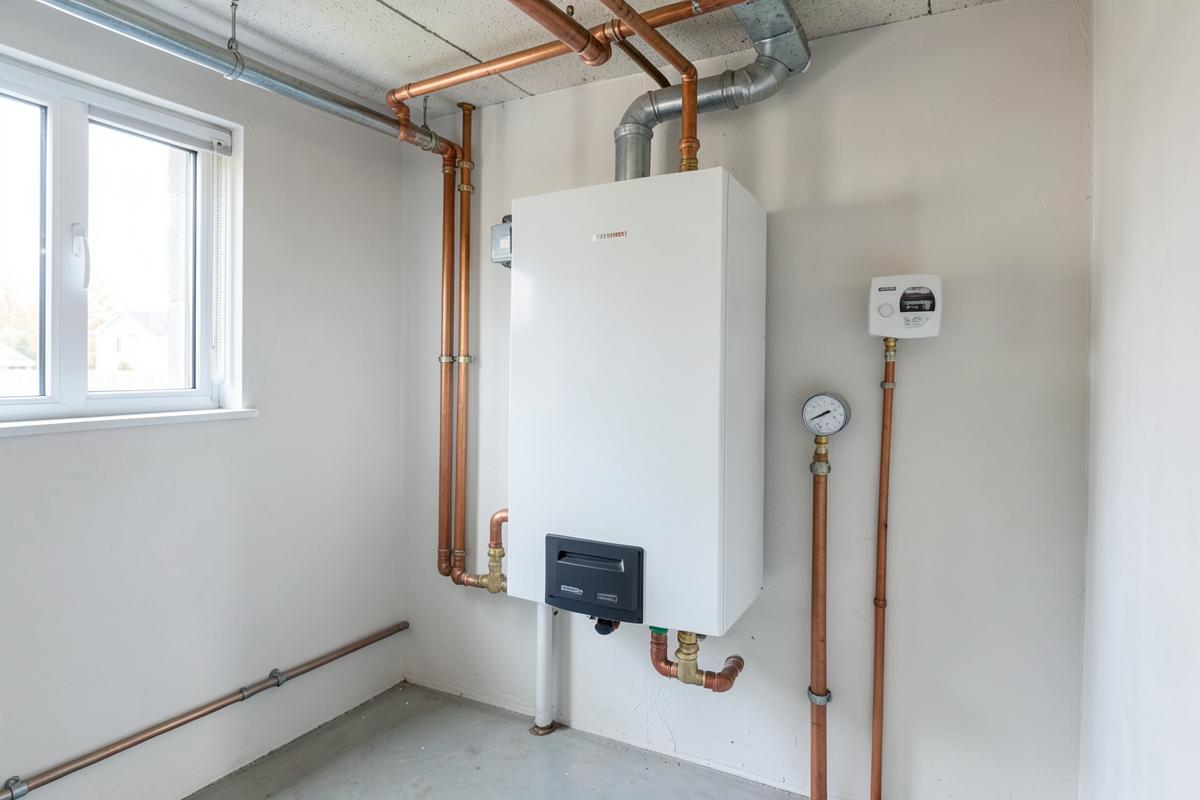
If you heat with hot water or steam and your boiler is old enough that replacement keeps coming up, the first number anyone will quote you is AFUE. It is worth understanding before you compare proposals, because it explains most of the difference between an older boiler and a modern one — and because it is frequently oversold.
This guide is deliberately brand-neutral. The same principles apply whichever manufacturer you end up with, and the right answer depends far more on sizing, controls and installation quality than on the badge on the front panel.
What AFUE actually measures
AFUE stands for Annual Fuel Utilization Efficiency. It is a percentage that describes how much of the fuel a boiler burns over a heating season is converted into usable heat, with the remainder leaving through the flue and through cycling losses. A boiler rated at 80% AFUE turns roughly eighty cents of every fuel dollar into heat in the building under test conditions.
AFUE is a laboratory rating, not a promise about your building. It says nothing about heat lost through an uninsulated attic, a distribution system that never balanced properly, or a boiler that is twice the size the building needs. Those factors sit on top of the rating, which is why two identical boilers in two different houses will not produce identical bills.
For planned care rather than an active fault, review boiler maintenance in Chicago and report leaks or recurring shutdowns when booking.
If replacement is being considered after diagnosis, see what affects boiler replacement cost in Chicago before comparing written scopes; no single price fits every system.
Why many older boilers sit around 80%
Conventional atmospheric and induced-draft gas boilers are typically rated in the low-to-mid 80% range, and many units installed decades ago are around 80% AFUE. That is not a defect; it is how the design works. Those boilers vent hot combustion gases up a chimney or flue, and that heat leaves the building along with the exhaust.
Age adds to it. Scale on the heat exchanger surfaces, burners that are out of adjustment, oversized replacement units chosen by matching the plate on the old boiler, and controls that were never set up properly all pull real-world performance below the original rating. In practice, an old boiler in a building nobody has serviced recently often performs worse than the number stamped on it.
How modern condensing boilers differ
A condensing boiler is built to recover heat that a conventional boiler sends up the flue. It runs cooler return water through a secondary heat exchanger, condenses moisture out of the exhaust, and captures the energy released in the process.
Depending on the model and how it is applied, modern condensing boilers are commonly rated somewhere in the mid-to-high 90% AFUE range — the exact figure is model-dependent and set by the manufacturer, so read the rating for the specific unit being quoted rather than assuming a category number.
There is an important condition attached. A condensing boiler only condenses when return water temperatures are low enough. Installed on an old high-temperature radiator loop with no outdoor reset or modulating control, a high-efficiency boiler can spend much of the season running outside its condensing range and delivering less than its rating suggests. That is a design and controls question, and it is where the difference between a good installation and a cheap one shows up.
What an upgrade may mean for your gas bill
Replacing an older, inefficient boiler with a properly sized, correctly installed high-efficiency boiler may reduce gas use and help lower the gas bill. It is not possible to promise a percentage or a dollar amount in advance, and you should be cautious of anyone who does.
Actual results depend on your existing equipment and its condition, the building itself and its insulation, the weather that winter, how the new boiler is sized, the distribution system and controls, the quality of the installation, and how the building is actually used. Two neighbours with the same boiler and different thermostat habits will not see the same outcome.
- Correct sizing — a heat-loss calculation rather than matching the nameplate on the old unit
- Low return water temperatures and outdoor reset so a condensing boiler can actually condense
- Modulation that matches output to the load instead of firing full-blast and shutting off
- Sound near-boiler piping, purged loops and correctly set circulators
- Balanced radiators or zones so heat reaches the rooms that need it
- Annual service, which keeps whatever efficiency you paid for from eroding
Is replacement the right call yet?
Plenty of boilers we look at should simply be repaired. A failed circulator, zone valve, aquastat or low-water cutoff on an otherwise sound boiler is normal maintenance, not a reason to replace a system with years left in it. Replacement becomes the honest recommendation when a boiler is well past its service life, when the section or heat exchanger is compromised, when repairs are stacking up in the same season, or when a renovation has changed what the building needs.
When it is close, ask for both numbers. We quote the repair and a replacement side by side, including the venting, gas and condensate work a condensing boiler requires, so you can see the whole picture rather than an equipment price.
For current faults and no-heat calls, see boiler repair.
For replacement scope, sizing and startup testing, see boiler installation and replacement.
Furnaces, heat pumps and controls are covered on our heating services page.
Commercial boilers, rooftop heat and building controls fall under commercial heating and mechanical service.
Ask us if a high-efficiency boiler makes sense for your home
The only way to answer that properly is to look at the boiler you have, the distribution system it feeds and the building around it. We will tell you plainly if the existing boiler should be repaired and left alone, and if an upgrade does make sense we will explain what the venting, condensate and control work involves before anything is ordered.
For Des Plaines and the surrounding suburbs, call 847-550-3322. For a Chicago address, call 773-250-6060.
Frequently asked questions
What does AFUE mean on a boiler?
AFUE stands for Annual Fuel Utilization Efficiency. It is the percentage of the fuel burned over a heating season that becomes usable heat in the building, with the rest lost through the flue and through cycling. It is a laboratory rating, so it describes the equipment rather than your building.
Is an 80% AFUE boiler bad?
No. Conventional gas boilers are typically rated in the low-to-mid 80% range by design, and many older units sit around 80% AFUE. A well-maintained 80% boiler that is correctly sized can serve a building reliably for years. The question is whether its age, condition and repair history justify replacing it.
How efficient are modern condensing boilers?
Modern condensing boilers are commonly rated somewhere in the mid-to-high 90% AFUE range, but the exact figure is model-dependent and set by the manufacturer. Always read the rating for the specific unit being quoted rather than assuming a number for the category.
How much will a high-efficiency boiler save on my gas bill?
No honest figure can be given in advance. A properly sized, correctly installed high-efficiency boiler may reduce gas use and help lower the gas bill, but actual results depend on the existing equipment, the building, the weather, sizing, controls, installation quality and how the building is used. We will not promise a percentage or a dollar amount.
Will a condensing boiler work with my old radiators?
Often yes, but the design matters. A condensing boiler only reaches its rated efficiency when return water temperatures are low enough to condense. On a high-temperature radiator loop it needs outdoor reset and modulating controls, and sometimes distribution changes, to spend meaningful time in its condensing range.
Should I repair my boiler or replace it?
Repair is usually right for a failed circulator, zone valve, aquastat or control on an otherwise sound boiler. Replacement deserves serious consideration when the boiler is well past its service life, the heat exchanger or sections are compromised, or repairs keep stacking up. We price both so the decision is yours.
Talk to Right Away
AFUE is a useful number and a poor substitute for a proper assessment. An older boiler around 80% AFUE genuinely uses more fuel than a modern condensing boiler in the mid-to-high 90% range, but the gain only materialises when the new equipment is sized for the building, piped correctly and controlled properly.
Ask us if a high-efficiency boiler makes sense for your home. Call 847-550-3322 for Des Plaines and the suburbs, 773-250-6060 for Chicago, or request service online.
Right Away Plumbing and HVAC is based at 2093 Rand Rd, Des Plaines, IL 60016 and is licensed, bonded and insured.
You can read more about our plumbing services, check the communities we serve, or start with plumbing in Des Plaines and Park Ridge. Planning a remodel or weighing a big replacement? Our consulting service is built for that conversation.