Commercial HVAC Repair in Chicago: What Building Managers Should Report Before Service
· 8 min read · Right Away Plumbing and HVAC
When a commercial HVAC problem gets reported as “the building is cold,” the first part of the service call is spent figuring out what that actually means. Which area? Which unit? Since when? A building manager who can answer those questions before the technician arrives usually gets a faster diagnosis, because the technician can go straight to the equipment that matters instead of surveying the whole building.
This checklist is what we ask about when a Chicago property calls in a commercial HVAC repair. None of it requires tools, panels to be opened or a trip onto the roof. It is the information a manager, engineer or front-office staff member can gather safely from inside the building.
1. Work out how much of the building is affected
The single most useful fact is the size of the problem. A complaint that affects the whole building points toward central equipment — a boiler, a main air handler, a building-control issue or a utility problem. A complaint limited to one floor, one tenant suite or one zone usually points toward the equipment or controls serving that area: a single rooftop unit, a zone damper, a pump or a thermostat.
Before calling, walk or call through the building and note which spaces are comfortable and which are not. “Suites 200 through 204 are cold, the rest of the second floor is fine” is a far better starting point than “no heat.”
2. Record the equipment and the symptoms
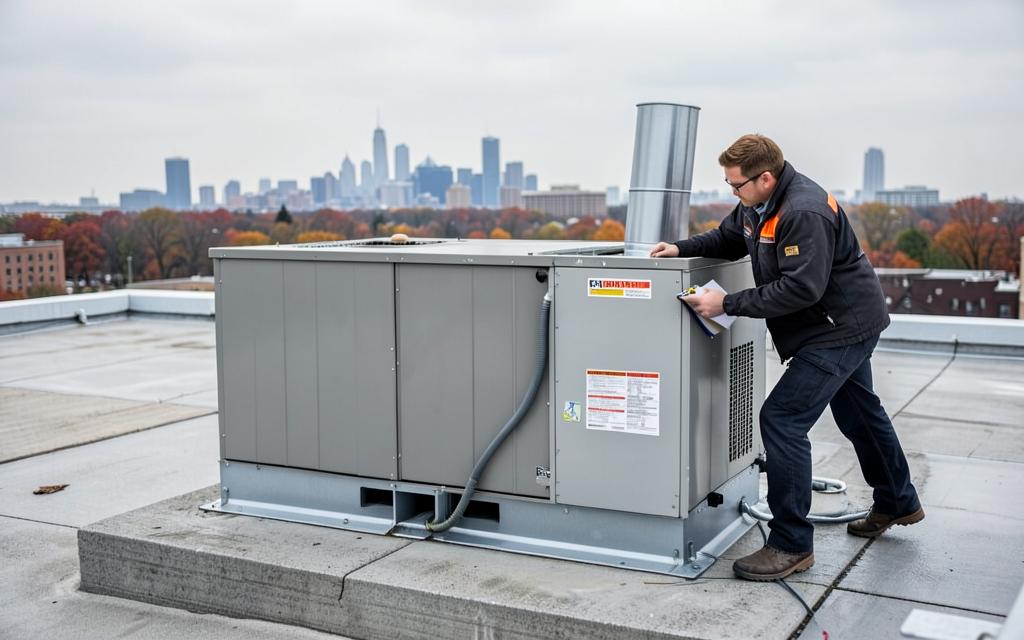
If the equipment tag is safely visible — from a roof hatch window, a mezzanine or a ground-level pad — note the unit number or equipment type. Most buildings label rooftop units (RTU-1, RTU-2 and so on), and matching the complaint to the right unit saves real diagnostic time. Do not climb onto an unsafe roof or open any panel to get this information; if it is not already visible, say so and let the technician handle it.
Then write down what the system is actually doing:
- What the thermostat or building-control screen shows, including any fault or alarm message
- Whether the supply fan runs, and whether the air coming from the registers is warm, cool or room temperature
- Any unusual smells (burning, gas, musty), noises (grinding, banging, squealing) or visible leaks
- When the symptoms started, and whether they are constant or come and go at certain times of day
- Anything that changed recently — a power outage, a control update, other work in the building
In plain words: what this means
In plain words: the more specific the report, the less time the technician spends hunting. “RTU-3 serves the east wing, the fan runs but the air is cold, and the control screen shows a fault code since Tuesday morning” can cut an hour of guesswork out of the visit.
3. What not to do before service
A few well-meant actions make the repair harder or create a safety problem:
- Do not open equipment panels or electrical compartments
- Do not repeatedly reset a unit that has locked out — a reset can erase the fault history the technician needs, and a safety that keeps tripping is doing its job
- Do not bypass or jumper any safety control to keep equipment running
- Do not go onto a roof that is icy, wet or otherwise unsafe to gather information
- If there is a gas smell, treat it as a gas problem first: leave the area, avoid switches and flames, and follow the gas utility's emergency guidance before arranging HVAC service
4. What the technician will actually trace
Commercial HVAC diagnosis follows the sequence of operation — the ordered steps the equipment goes through from a call for heat or cooling to a satisfied thermostat. The technician confirms what the controls are asking for, then follows the sequence until something does not happen: ignition and flame proving, the heat section, the supply fan and airflow, belts and bearings, the economizer and its dampers, or the pumps, valves and boiler on a hydronic system.
That is why the information above matters. If the fan runs but there is no heat, the technician starts at the heat section and ignition. If one zone is cold while the rest of the building is warm, the focus shifts to that zone's damper, sensor, pump or control schedule rather than the central equipment.
For the full scope of what we service, see our commercial HVAC and mechanical services page, or the
details on commercial heating and rooftop unit repair.
5. Repair versus replacement: planning without surprises
On older commercial equipment, a repair visit sometimes turns into a bigger conversation: the unit is at the end of its expected life, a major component has failed, or the same fault keeps coming back. A honest assessment compares the repair cost and the equipment's condition against its age and service history — without promising savings that depend on how the building actually operates.
The practical approach is to ask for the findings in writing: what failed, what it costs to repair, what else on the unit is near the end of its life, and what replacement would involve. That gives ownership something concrete to approve, budget or defer.
Our mechanical inspection service produces exactly that kind of written condition report, and our
mechanical consulting work helps owners and managers plan replacements and retrofits before equipment fails in season.
6. Preventive maintenance and written reporting
Most mid-winter commercial failures announce themselves weeks earlier — a belt glazing, a bearing getting louder, a heat exchanger showing wear, a control drifting out of calibration. Scheduled maintenance visits catch those items while they are still cheap, and each visit should end with a written report: what was checked, what was found, what was done and what to budget for.
For a management company with several buildings, written condition reports are what turn HVAC from a series of emergencies into a line item that can be planned. If your building does not have a current equipment list and maintenance history, that is the first thing to build.
Frequently asked questions
What should a building manager report before a commercial HVAC service call?
Report which areas of the building are affected, the unit number or equipment type if it is safely visible, what the thermostat or control screen shows, whether the fan runs, any smells, noises or leaks, and when the symptoms started. Specific information shortens the diagnosis considerably.
Why does one area have no heat while the rest of the building is warm?
A single cold zone usually points to the equipment or controls serving that zone rather than the central system: a zone damper stuck closed, a failed pump or valve on a hydronic loop, a sensor in a bad location, an outdated control schedule, or one rooftop unit locked out while the others run. The technician checks that zone's controls and equipment first.
Should a rooftop HVAC unit be reset before service?
No. Repeatedly resetting a faulted unit can erase the fault history the technician needs and runs the equipment through the same failed sequence again. If a unit locks out or a safety keeps tripping, record the fault code or message and leave the unit off until it is diagnosed.
How often should commercial HVAC equipment be inspected?
At minimum, heating equipment should be inspected before the heating season and cooling equipment before the cooling season, with filter and belt checks more often depending on the building's use. Restaurants, salons and high-traffic spaces load filters faster than quiet offices. Each visit should produce a written condition report so owners can plan repairs and replacements.
Talk to Right Away
Right Away Plumbing & HVAC services commercial rooftop units, boilers, make-up air and controls for businesses and managed properties from our shop at 2093 Rand Rd, Des Plaines, IL 60016. Chicago properties call 773-250-6060; Des Plaines and the suburbs call 847-550-3322.
When you call, have the checklist above in front of you — which areas are affected, what the controls show and when it started. It is the fastest route to a correct diagnosis.
You can read more about our plumbing services, check the communities we serve, or start with plumbing in Des Plaines and Park Ridge. Planning a remodel or weighing a big replacement? Our consulting service is built for that conversation.
Service areas for this work include Chicago and Des Plaines. Questions about your building? Use our contact page.