Commercial Rooftop Heating Checklist: What Chicago Property Managers Should Test Before Winter
· 10 min read · Right Away Plumbing and HVAC
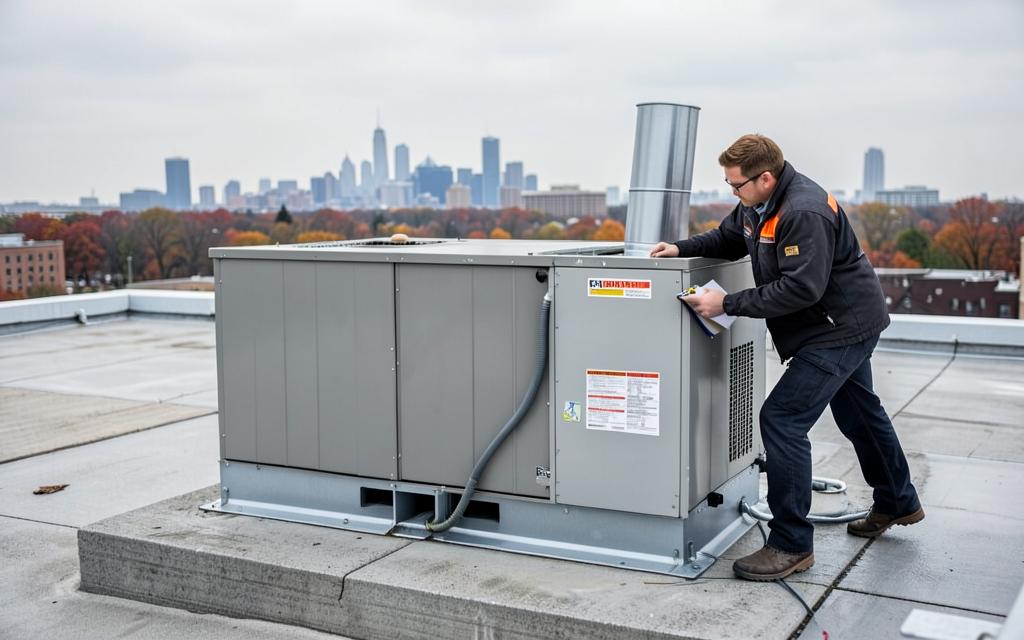
The first cold morning is a poor time to discover that one rooftop unit has not produced heat since spring. A packaged rooftop unit may run its fan normally while the heating section remains locked out, an economizer brings in too much cold outdoor air, or a thermostat follows an outdated schedule. From inside the building, each problem can sound the same: “The unit is running, but this area is cold.”
Early fall gives Chicago property managers and building owners time to test equipment, document problems and schedule repairs before prolonged cold weather increases service demand. The objective is not simply to hear a rooftop unit start. It is to confirm that each occupied zone receives usable heat, the controls follow the correct schedule and the equipment completes a normal operating cycle without tripping a safety device.
This checklist explains what building staff can observe safely and what should be left to a qualified commercial HVAC technician.
1. Match every rooftop unit to the space it serves
On a roof with several similar units, the first challenge is often identifying the correct equipment. Before testing, update the equipment list with each unit's location, model and serial number when available, thermostat or control zone, tenant or department served, filter size and recent repair history.
A simple roof plan and consistent unit labels help prevent wasted diagnostic time. They also make it easier to explain a problem when requesting service. Instead of reporting that “the back of the building is cold,” staff can identify the affected suite, thermostat and rooftop unit.
For multi-property portfolios, use the same naming system at every location and keep service pictures with the equipment record. This supports faster decisions when a unit requires a part, a return visit or replacement planning.
Bring that equipment list with you when you request commercial heating and rooftop HVAC service.
2. Run every unit through a complete heating cycle
Do not assume that a cooling system that worked in August will heat correctly in October. Heating uses a different operating sequence and may depend on separate ignition components, gas controls, electric heat stages, heat-pump controls or safety devices.
During a mild-day test, authorized building staff can observe:
- Whether the thermostat or building-control system calls for heat
- Whether the supply fan starts at the expected point
- Whether the air becomes warm at the occupied-space supply registers
- Whether the unit operates long enough to affect room temperature
- Whether it shuts down normally after the thermostat is satisfied
- Whether an alarm, lockout or unusual noise appears
Record what you observe
Record the time, outdoor temperature, thermostat setting and affected area. “Heat started” is useful, but “RTU-3 supplied warm air to Suite 204 for a complete cycle with no alarm” gives the service technician much better information.
Repeatedly resetting a unit can erase fault history or place equipment through the same failed sequence again. If the unit locks out, cycles off quickly, produces a burning or gas odor, or trips an electrical device, stop and request professional service.
3. Check filters and airflow before blaming the heating section
Restricted airflow can create poor comfort, excessive temperature rise and nuisance limit trips. Filter service should follow the equipment manufacturer's requirements and the building's actual operating conditions. A restaurant, salon, workshop or high-traffic retail space may load filters differently from a quiet office.
Check that:
- The correct filter size and type are installed
- Filters are seated properly without large bypass gaps
- The replacement schedule reflects actual dirt loading
- Supply and return openings are not blocked
- Registers serving the cold area are open and moving air
What a clean filter does not prove
A clean filter does not prove that the blower, belt or distribution system is functioning correctly, but it removes one common restriction from the diagnosis. If airflow remains weak, a technician should inspect the blower assembly, belt condition, motor operation, cabinet and accessible distribution components.
4. Have the burner, ignition and safety sequence inspected
Gas-fired rooftop heating sections may include an inducer, pressure switch, ignition control, igniter or pilot system, gas valve, burners, flame sensor, heat exchanger and temperature or rollout safety devices. A fault in this sequence can allow the fan to run while preventing dependable heat.
This work involves gas, combustion products, electricity and moving equipment. Building staff should not bypass a switch, force a gas valve, open energized compartments or repeatedly reset a failed unit.
A qualified technician can inspect the accessible heat exchanger and burner section, verify the ignition sequence, evaluate flame proving and safety devices, and determine why a unit is cycling or locking out.
Call promptly if occupants report a gas odor, visible smoke, soot, unusual combustion noise or a carbon-monoxide alarm. Follow the property's safety and utility procedures and keep occupants away from an unsafe area.
5. Verify blower belts, bearings and fan operation
Some packaged units use belt-driven supply fans. A worn, loose or damaged belt may move some air without delivering the airflow the space needs. Bearings, pulleys, motors and electrical controls can also create noise, vibration or intermittent operation.
During the indoor portion of the test, note squealing, scraping, repeated starts, vibration and changes in airflow. A technician can safely isolate power before opening the unit, inspect the drive components and determine whether adjustment or replacement is appropriate.
Planned work is easier to coordinate around tenants and business hours than an unplanned shutdown during cold weather.
6. Test economizers and outdoor-air dampers
An economizer uses outdoor air when conditions allow. When a damper, actuator, sensor or control sequence is incorrect, the unit may introduce too much cold outdoor air during heating operation. The heating section can be operating while the occupied space still feels cold.
A commercial HVAC technician or controls professional should compare the control command, actual damper position and temperature readings instead of assuming that the heating equipment itself has failed.
This is especially important when tenants complain that one area is cold only at certain times, during windy weather or after a control change. Outdoor-air operation, exhaust and building pressure may be part of the same complaint.
7. Review thermostat, building-control and holiday schedules
A rooftop unit may be mechanically capable of heating but receive the wrong command because of:
- An outdated occupied or unoccupied schedule
- Incorrect day, time or holiday programming
- A thermostat located near a door, kitchen or sunny window
- A failed or inaccurate temperature sensor
- Conflicting setpoints between adjacent zones
- A building-automation override that was never cleared
- A tenant improvement that changed the space without updating the controls
Compare the schedule with actual building hours
Compare the programmed schedule with the building's actual operating hours. Test early-opening, late-closing and weekend areas separately.
Also review vacant suites, stockrooms and other spaces containing water piping. They may need appropriate temperature monitoring even when people are not regularly present.
When control problems keep repeating across a portfolio, our commercial HVAC and mechanical consulting can help you plan the fix rather than repeat the service call.
8. Include make-up air, unit heaters and commercial boilers
Rooftop units may not be the building's only heat source. Warehouses can use unit heaters, restaurants may depend on tempered make-up air, and multifamily or mixed-use properties may have commercial boilers serving radiators or hydronic loops.
Test the complete heating system that supports building operations. A restaurant exhaust system can change comfort and pressure conditions when make-up air is not operating correctly. A working boiler may still leave part of a building cold when a pump, valve, control or distribution problem prevents heat from reaching the affected zone.
Document which equipment serves each area and whether one system depends on another.
When the building also uses a steam or hydronic plant, review commercial boiler repair in Chicago.
For scheduled boiler-specific checks, see boiler maintenance in Chicago.
Our mechanical services cover rooftop units, unit heaters, make-up air and commercial boilers together.
If doors are hard to open or the kitchen hood stops capturing smoke while exhaust fans run, the building may be under negative pressure from a make-up air problem.
9. Coordinate safe roof access and inspect the surroundings
Rooftop work requires controlled access and proper fall-protection practices. Building staff should not climb onto a roof or open equipment unless they are authorized, trained and properly equipped.
From an approved access route, qualified personnel should note conditions that can affect service or equipment operation, including damaged access points, standing water, blocked roof drains, loose debris, deteriorated cabinet panels and unsafe approaches to equipment.
HVAC service does not replace a professional roof inspection, and an HVAC technician should not be asked to perform roofing repairs outside the agreed scope.
Before scheduling service, provide information about access keys, ladders, roof hatches, escorts, tenant restrictions and operating hours.
10. Decide what needs repair and what belongs in the capital plan
A fall inspection may identify a small repair, a maintenance item or an aging unit that deserves replacement planning. Age alone does not determine the answer.
Consider the unit's condition, repair history, heat-exchanger or compressor condition, parts availability, controls, efficiency, building plans and the operational cost of another failure.
For a building with several similar units, document the condition of the entire group. Replacing every unit at once may not be practical, but a staged plan can prioritize unreliable or critical equipment across more than one budget year.
A plumbing and HVAC property inspection can provide pictures, equipment information, condition notes and priorities before a purchase, lease, renovation or capital-budget decision. Inspection findings reduce uncertainty but cannot guarantee future performance or reveal every concealed or intermittent condition.
Information to provide when requesting commercial heating service
This information helps route the appropriate technician and prepare for the building's access and operating requirements.
- Property address and on-site contact
- Business type and operating hours
- Affected tenant, suite, room or zone
- Rooftop-unit number or equipment label, if known
- What the thermostat or control system displays
- Whether the fan runs and whether the air is warm, cool or absent
- Any alarm, fault code, noise, odor or recent reset
- When the problem began and whether it is intermittent
- Roof-access instructions and required authorization
- Relevant repair history, pictures or equipment records
You can send those details through our contact page or call the number for your location.
Commercial service across Chicago and the suburbs
We work on commercial heating equipment throughout Chicago and the surrounding Cook and DuPage County communities.
See every community on our service areas page.
City pages: Chicago — call 773-250-6060 for a Chicago address.
Suburban coverage includes Des Plaines, where our shop is located.
We also serve commercial properties in Schaumburg.
Office and retail buildings in Oak Brook are within our commercial service area.
Warehouse and light-industrial work in Addison is covered as well.
The same applies to Rolling Meadows.
Frequently asked questions
When should a Chicago commercial rooftop unit be tested for heat?
Test it before sustained cold weather, while there is time to diagnose problems and coordinate planned repairs. The exact maintenance schedule should follow the equipment manufacturer's requirements, operating environment, usage and service history.
Why does a rooftop unit run but blow cold air?
Possible causes include a thermostat or scheduling problem, ignition failure, gas-control problem, safety lockout, airflow restriction, failed heat stage or an economizer introducing too much outdoor air. The operating sequence must be tested to identify the cause.
Can building staff reset a locked-out rooftop unit?
Follow the manufacturer's instructions and the property's safety procedures. Do not repeatedly reset equipment, bypass safety devices or work inside gas or energized electrical compartments. A repeated lockout needs professional diagnosis.
What information helps a commercial HVAC technician arrive prepared?
Provide the affected zone, unit label, thermostat display, symptoms, fault codes, recent reset or repair history, operating hours and roof-access instructions. Pictures of the equipment label or control display can also help.
Do commercial rooftop units need maintenance every fall?
Fall is a practical time to verify heating operation, but the appropriate frequency and scope depend on the manufacturer, equipment type, environment, operating hours and maintenance history. High-use or dirty environments may require more frequent attention.
Does Right Away service rooftop units in Chicago and the suburbs?
Yes. Right Away provides commercial rooftop heating and mechanical service in Chicago and surrounding Cook and DuPage County communities. Call 773-250-6060 for Chicago or 847-550-3322 for Des Plaines and the suburbs.
Talk to Right Away
Right Away Plumbing and HVAC provides commercial rooftop-unit, heating and mechanical service for offices, retail properties, restaurants, warehouses, multifamily buildings and other commercial facilities throughout Chicago and the surrounding suburbs.
We can test heating operation, diagnose no-heat complaints, document findings and help plan repairs or equipment replacement around the property's needs.
For a Chicago address, call 773-250-6060. For Des Plaines and the surrounding suburbs, call 847-550-3322 or request service online.
Right Away Plumbing and HVAC is based at 2093 Rand Rd, Des Plaines, IL 60016 and is licensed, bonded and insured.
You can read more about our plumbing services, check the communities we serve, or start with plumbing in Des Plaines and Park Ridge. Planning a remodel or weighing a big replacement? Our consulting service is built for that conversation.