What Does a Tripped Furnace Rollout Switch Mean?
· 10 min read · Right Away Plumbing and HVAC
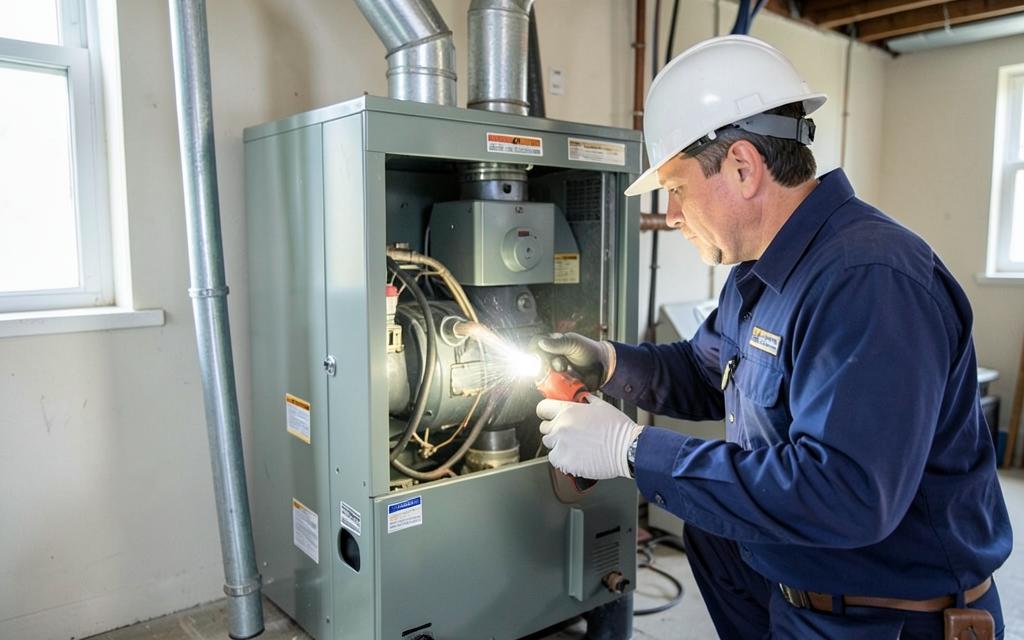
A rollout switch is a safety control, not a nuisance part. When it opens, the furnace stops because heat or flame was detected outside the area where combustion belongs. Shutting the furnace down is the switch doing exactly what it was designed to do.
A tripped rollout switch can indicate an unsafe combustion or overheating condition. Leave the furnace off and request professional diagnosis. Do not reset the rollout switch unless the manufacturer's owner instructions for that exact model explicitly direct the homeowner to do so.
This guide explains what the control protects, how a rollout trip differs from a high-limit shutdown, the range of conditions that can cause one, and the point at which the safest action is to leave the building and call for help.
Right Away Plumbing and HVAC diagnoses gas furnace safety shutdowns for homes in Des Plaines, Chicago and the surrounding suburbs.
What a rollout switch does
In a normally operating gas furnace, the burner flames are drawn into the heat exchanger and combustion gases leave the home through the vent. A rollout switch is mounted near the burner compartment to sense heat or flame that has rolled out of that path instead of being pulled in.
When the switch senses that condition, it opens the control circuit and shuts off the gas valve. Many rollout switches are manual-reset devices, and some are one-time fuse links that must be replaced rather than reset. Either way, the switch is reporting a condition upstream of itself; it is not usually the fault.
For the broader diagnosis beyond this symptom, see what can cause a furnace to stop working; the visible FAQ separates safe observations from technician-only checks.
City homes can review residential furnace repair in Chicago.
Why you should not bypass or reset it
A tripped rollout switch can indicate an unsafe combustion or overheating condition. Leave the furnace off and request professional diagnosis. Do not reset the rollout switch unless the manufacturer's owner instructions for that exact model explicitly direct the homeowner to do so.
Jumping, taping, wiring around or replacing a rollout switch with a piece of wire removes the protection entirely. Flame rollout can scorch wiring and nearby materials and can accompany combustion or venting problems that produce carbon monoxide. No comfort benefit is worth running a gas appliance with its safety chain defeated.
- Do not bypass, jumper or remove a rollout switch
- Do not reset the rollout switch unless the manufacturer's owner instructions for that exact model explicitly direct the homeowner to do so
- Do not open sealed combustion compartments or adjust gas controls
- Do turn the furnace off at the thermostat and the service switch until it is inspected
Rollout trip versus high-limit shutdown
Both controls shut the furnace down on heat, but they watch different places and mean different things.
Rollout switch
Located at or near the burner compartment. It responds to heat or flame outside the combustion path, which points toward combustion, venting, heat-exchanger or gas-supply conditions. Many are manual reset or one-time devices, which is a deliberate design choice: the equipment should not quietly restart itself after this kind of event.
High-limit switch
Located in the heated air stream. It responds to supply air that has become too hot, which more often points toward airflow: a restricted filter, closed or blocked registers, duct restrictions, or a blower that is not moving the air it should. Many high limits reset automatically once temperature falls, which is why that fault often shows up as short cycling rather than a hard stop.
The two can overlap. Poor airflow can contribute to overheating conditions that eventually show up at the burners, so a technician reads both controls as part of one picture rather than treating them as separate complaints.
Conditions that can cause a rollout trip
There is no single part to point at. A rollout trip is a symptom, and several unrelated faults can produce it. A proper diagnosis narrows the list by testing, not by guessing.
- Burner problems: dirt, rust, scale, spiders or debris in burner ports changing how the flame behaves
- Flame characteristics: lazy, lifting or misdirected flame instead of a steady, drawn-in burn
- Venting: a blocked, disconnected, undersized, frosted or improperly sloped flue, or a blocked intake on a high-efficiency furnace
- Draft: an inducer motor, pressure switch or blocked passage that is not establishing the draft the burners need
- Heat exchanger: cracks, soot, restriction or corrosion interfering with the combustion path
- Airflow: a badly restricted filter, blocked returns, collapsed duct or failing blower
- Gas pressure: incorrect supply or manifold pressure, or a regulator or valve problem
- Controls: a failed pressure switch, control board, gas valve or wiring fault affecting the ignition sequence
If you smell gas or a carbon-monoxide alarm sounds
This is the part of the article that is not about comfort. If a carbon-monoxide alarm sounds, or anyone feels headache, dizziness, nausea or confusion that eases outdoors, get everyone and any pets out of the building and call 911 from a safe location outside.
If you smell gas, do not operate light switches, appliances, garage doors or phones inside the building. Leave immediately and call 911 and your gas utility from a safe location away from the property. Do not return until emergency responders or the utility say it is safe.
Do not try to locate the source, ventilate the house or restart the furnace yourself. Service diagnosis comes after the building has been made safe.
What professional diagnosis looks at
A rollout diagnosis is a sequence, not a part swap. The technician confirms the condition of the burners and heat exchanger, verifies draft and venting, checks gas supply and manifold pressure against the equipment rating, tests the safety circuit and controls, and evaluates airflow across the system.
The rollout switch itself is inspected and replaced when it has failed or is a one-time device, but replacing it is the last step, not the fix. If the cause cannot be identified and corrected, the correct outcome is to leave the furnace shut off and explain why.
Right Away handles this as a diagnostic visit through our furnace repair service, and can advise on replacement when the equipment no longer supports a safe repair.
Repair or replacement considerations
Many rollout causes are repairable: cleaning and correcting burners, clearing or correcting venting, restoring airflow, or replacing a failed control. Repair is usually the reasonable path when the heat exchanger is sound, the equipment is in good condition and the fault is a normal wear or maintenance item.
Replacement enters the conversation when the heat exchanger is compromised, when corrosion or damage is widespread, when the furnace is well past its service life, or when repeated safety shutdowns show the equipment can no longer be operated reliably. We do not quote a price in an article, and we will not promise savings, rebates or an outcome before the equipment has been inspected. Any applicable warranty terms are explained in writing at the time of the work.
If replacement is the honest answer, our furnace installation page explains how sizing, venting and combustion-air planning are handled, and our broader heating services are listed on the
heating service page. Buyers and property managers can also request a documented evaluation through our
Serving Chicago and the suburbs
Older Chicago-area housing stock, shared chimneys, long heating seasons and hard freezes all put pressure on combustion and venting. That is a common backdrop for the conditions described above, especially on the first cold weekend after a furnace has sat idle since spring.
We diagnose gas furnace shutdowns in Chicago at 773-250-6060, in
Des Plaines and the surrounding suburbs at 847-550-3322, and across the rest of our
service areas. You can also reach us through the
contact page. Our office is at 2093 Rand Rd, Des Plaines, IL 60016.
Frequently asked questions
Can I just reset my furnace rollout switch?
A tripped rollout switch can indicate an unsafe combustion or overheating condition. Leave the furnace off and request professional diagnosis. Do not reset the rollout switch unless the manufacturer's owner instructions for that exact model explicitly direct the homeowner to do so.
What is the difference between a rollout switch and a high-limit switch?
A rollout switch senses heat or flame outside the combustion path near the burners and points toward combustion, venting or heat-exchanger conditions. A high-limit switch senses supply air that is too hot and more often points toward airflow problems such as a restricted filter or failing blower.
Does a tripped rollout switch mean my heat exchanger is cracked?
Not necessarily. A cracked or restricted heat exchanger is one possible cause, but burner condition, venting, draft, airflow, gas pressure and control faults can produce the same shutdown. Testing is required before any single part is blamed.
Is it safe to run my furnace after the rollout switch trips?
No. The control opened because a condition was detected that the equipment is not supposed to operate with. Turn the furnace off at the thermostat and the service switch, use safe supplemental heat if needed, and have the system inspected.
What should I do if my carbon-monoxide alarm sounds?
Get everyone and any pets out of the building and call 911 from a safe location outside. Do not restart the furnace or search for the source. If you smell gas, leave without operating switches or appliances and call 911 and your gas utility from outside.
Should the switch itself be replaced?
Sometimes. Some rollout devices are one-time fuse links and must be replaced, and any switch that has failed is replaced during the repair. Replacing the switch alone, without correcting the condition that opened it, is not a repair.
Who do I call for furnace diagnosis in Chicago or the suburbs?
Right Away Plumbing and HVAC diagnoses gas furnace safety shutdowns throughout the area. Call 773-250-6060 for Chicago addresses or 847-550-3322 for Des Plaines and the surrounding suburbs.
Talk to Right Away
A rollout switch that trips is information worth acting on. Leave the furnace off and let a technician test the burners, venting, airflow, gas pressure and controls as one system before anything is replaced. Do not reset the rollout switch unless the manufacturer's owner instructions for that exact model explicitly direct the homeowner to do so.
Call 847-550-3322 for Des Plaines and the suburbs, or 773-250-6060 for Chicago, to schedule a furnace diagnosis. We are based at 2093 Rand Rd, Des Plaines, IL 60016.
You can read more about our plumbing services, check the communities we serve, or start with plumbing in Des Plaines and Park Ridge. Planning a remodel or weighing a big replacement? Our consulting service is built for that conversation.