
Are You Okay? Is a Higher-MERV Furnace Filter Always Better?
· 7 min read · Right Away Plumbing & HVAC
A homeowner standing in the filter aisle usually sees one number: the MERV rating. It is tempting to buy the highest one on the shelf and assume the house is better off. Sometimes that works fine.
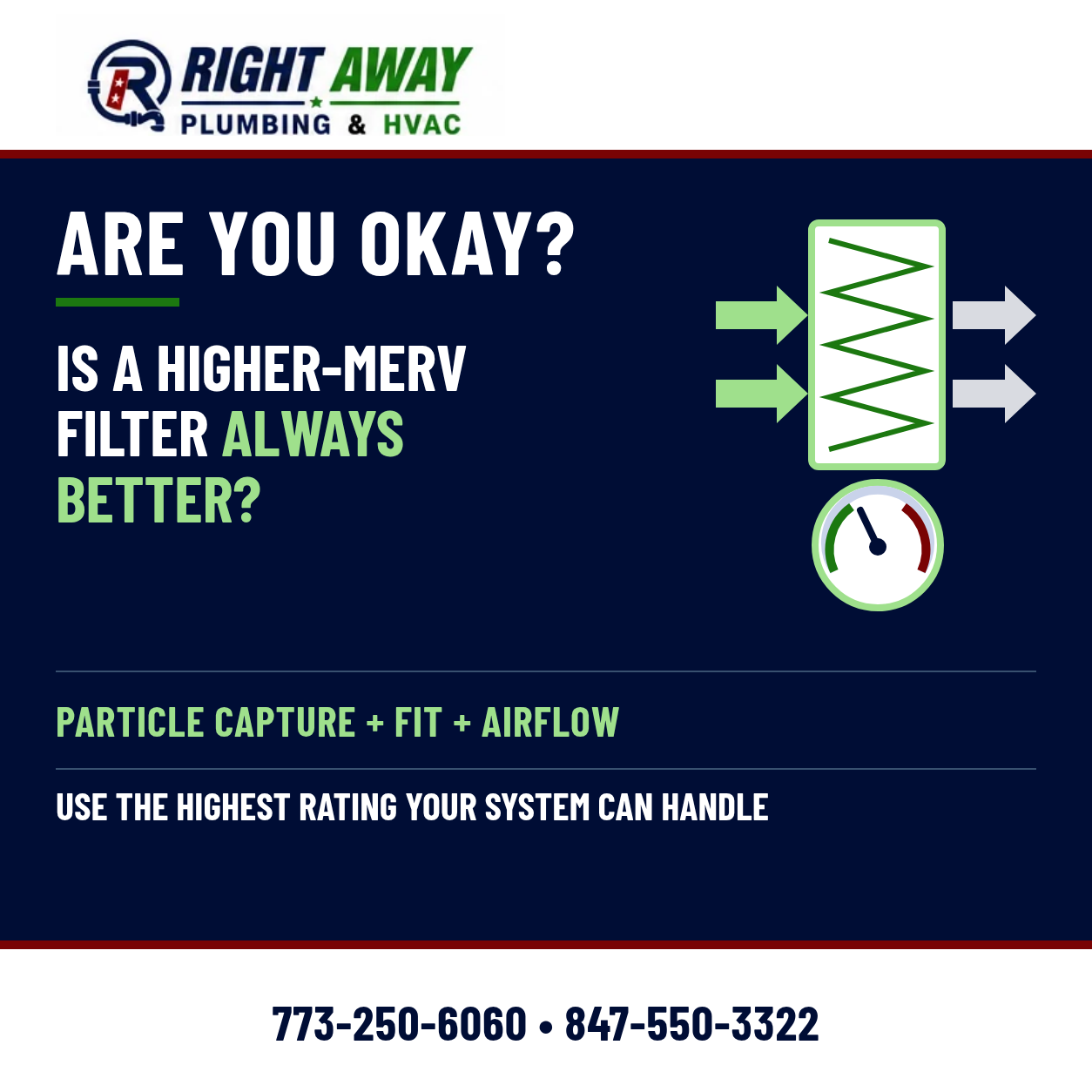
Sometimes the furnace starts running hot, rooms get weaker airflow, or the filter bows inward within weeks. The rating matters, but it answers only one of three questions: how well the filter captures particles, whether it fits, and how much it restricts air your system can actually move.
What a MERV rating actually tells you
MERV stands for Minimum Efficiency Reporting Value. It comes from a standardized laboratory test that measures how well a filter captures particles across set size ranges. In general, a higher MERV captures more of the tested particle sizes.
That is useful information, but it is a test result for the filter by itself. It does not tell you how much resistance that filter adds inside your particular furnace or air handler, whether air is slipping around the edges, or whether your blower can push enough air through it.
MERV rating, fit, and airflow are different questions
| Question | What it covers | How to check it |
|---|---|---|
| MERV rating | Tested particle-capture performance of the filter | Read the rating on the filter frame or packaging |
| Fit | Whether all air passes through the filter instead of around it | Match the exact size, seat it snugly, follow the airflow arrow |
| Airflow and pressure drop | How much the filter restricts the air your blower moves | Watch for warning signs; a technician can measure static pressure and temperature rise |
A filter can score well on capture and still be a poor match for a system with a small return, a narrow one-inch slot, or a blower that is already near its limit. The aim is the highest rating your system can handle without restricting airflow, not the highest rating sold.
Why higher is not automatically better
Every filter adds some resistance, called pressure drop. Denser media generally adds more, especially when it is packed into a thin frame with little surface area. Your blower, the filter rack, the return ductwork, and the available filter area together decide whether that extra resistance is a non-issue or a problem.
A deeper media cabinet spreads the same filtering material over much more surface, which can allow better capture with less restriction. A one-inch slot in a tight return gives far less room. That is why the same filter can work well in one house and cause trouble in the next.
Fit matters as much as the number
Air takes the easiest path. If the filter is undersized, loose, or the rack door does not close, air bypasses the filter and the rating stops meaning much. Buy the exact listed size, seat it fully, and point the arrow toward the blower in the direction of airflow.
Do not bend, trim, or crush a filter to make it fit. A distorted frame leaves gaps and can collapse into the blower compartment. If the correct size does not sit snugly, the rack or cabinet may need attention.
How often to check and change the filter
There is no single schedule for every home. Follow the filter and equipment manufacturer's guidance, then adjust to how fast the filter actually loads. Pets, renovation dust, and long run times in cold weather all load filters faster.
During heavy heating or cooling use, check the filter monthly. A dirty filter reduces airflow and makes the system work harder. Write the date and the rating on the frame so you can see how quickly it loads.
What a filter can and cannot do
An HVAC filter only works while air is moving through the system. When the blower is off, it filters nothing. MERV is not a diagnosis, a medical treatment, or a promise to remove every pollutant from a home.
Controlling the source of a pollutant, ventilation, and portable air cleaners are separate questions. EPA's guidance treats them that way, and so should any recommendation you receive. Health concerns belong with a qualified health professional.
Safe homeowner steps
Stop at the filter. Do not open burner or blower compartments on energized or gas equipment, and never bypass a limit switch or other safety control.
- Confirm the exact filter size and the airflow-arrow direction before buying.
- Turn the system off at the thermostat or service switch before changing an accessible filter.
- Note the old and new rating and the date you changed it.
- Keep return grilles and supply registers clear of furniture, rugs, and storage.
Signs the system needs a professional look
A technician can measure total external static pressure and temperature rise, check blower setup, look for duct and return restrictions, confirm the filter rack fits and seals, and discuss whether a deeper media cabinet makes sense for your system. Those measurements answer the question the filter label cannot.
- Repeated limit trips or short cycling, where the furnace starts and stops frequently.
- Noticeably weak airflow at registers.
- A hot or burning odor.
- Unusual blower noise.
- A filter that bows, collapses, or pulls out of its rack.
- A major temperature difference between rooms.
- Any of these starting right after a filter upgrade.
If the furnace is short cycling or overheating, request furnace repair diagnosis.
For a seasonal check of airflow and operation, see our boiler and furnace tune-up.
Browse all heating services.
Sources
EPA explains what a MERV rating measures and that higher ratings capture more of the tested particles, and its air-cleaner guide notes that HVAC filters work only while the system runs and that the system must be able to accommodate a higher-efficiency filter. ENERGY STAR recommends checking the filter monthly, especially during heavy use, and changing it when dirty.
EPA: Guide to Air Cleaners in the Home.
EPA: What is a MERV rating?.
ENERGY STAR: Heat & Cool Efficiently.
Frequently asked questions
Is a higher-MERV furnace filter always better?
Not always. A higher MERV generally captures more of the tested particle sizes, but it can also add more airflow resistance. The best choice is the highest rating your system can handle without restricting airflow.
What does a MERV rating measure?
MERV comes from a standardized lab test of how well a filter captures particles in set size ranges. It describes the filter alone, not how it performs in your specific furnace or ductwork.
How often should I change my furnace filter?
Follow the filter and equipment manufacturer's guidance and your actual conditions. Check it monthly during heavy heating or cooling use and replace it when it is dirty.
Does it matter if my filter is a little loose?
Yes. Air that bypasses a loose or undersized filter is not filtered. Use the exact size, seat it snugly, follow the airflow arrow, and never bend or crush a filter to fit.
When should I call for help after changing my filter?
Call if you notice repeated limit trips or short cycling, weak airflow, a hot or burning odor, unusual blower noise, a collapsing filter, or major room imbalance, especially if it started right after a filter upgrade.
Talk to Right Away
Right Away Plumbing & HVAC checks filter fit, static pressure, and blower setup before recommending a change. Chicago: 773-250-6060. Des Plaines and the suburbs: 847-550-3322. Our shop is at 2093 Rand Rd, Des Plaines, IL 60016.
You can read more about our plumbing services, check the communities we serve, or start with plumbing in Des Plaines and Park Ridge. Planning a remodel or weighing a big replacement? Our consulting service is built for that conversation.