
Are You Okay? Why Tap Water Looks Cloudy or Milky—and When a Filter Won’t Help
· 7 min read · Right Away Plumbing & HVAC
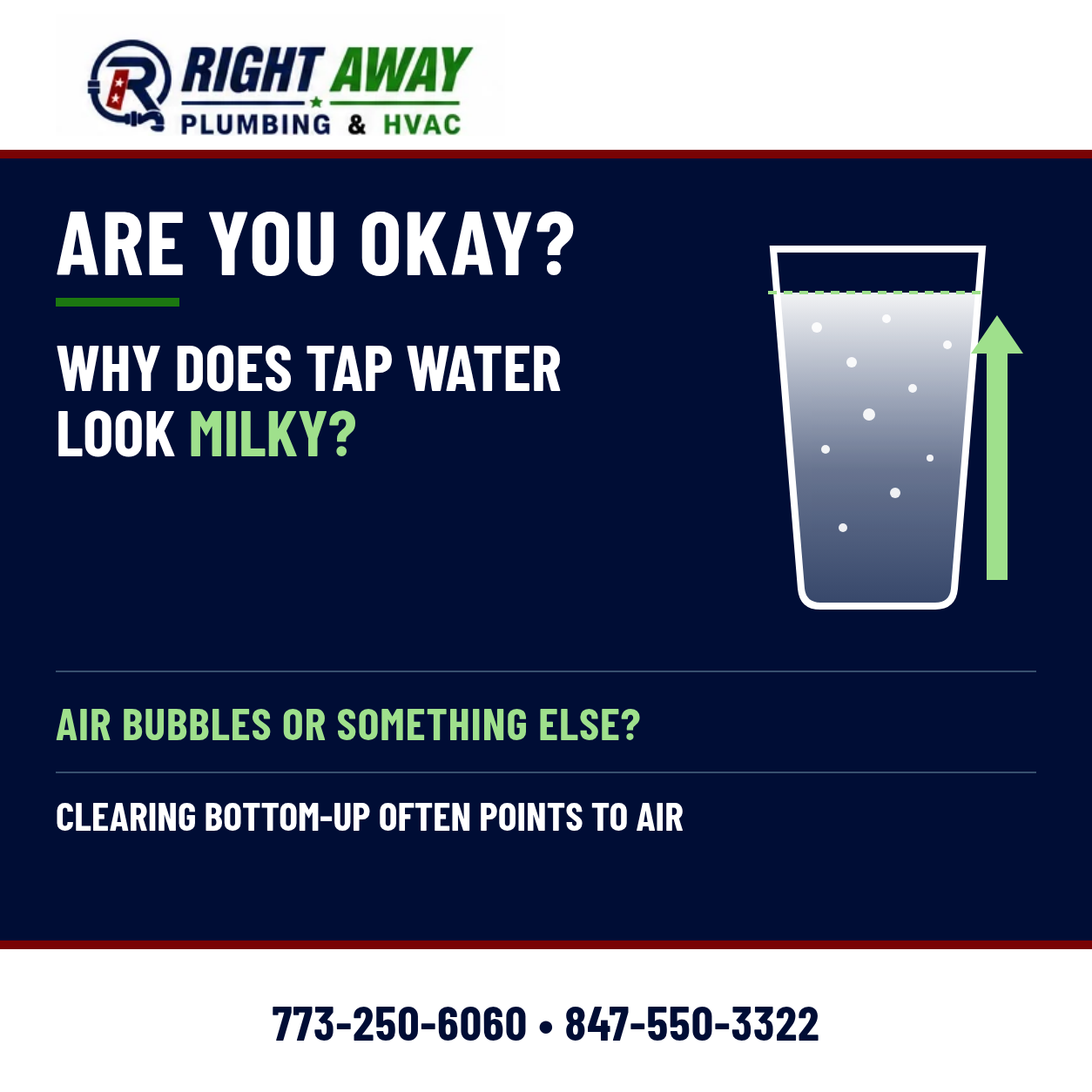
You fill a glass at the kitchen sink and it looks white, almost like skim milk. Set it on the counter and, a minute or two later, it may look perfectly clear. Homeowners ask us whether that means something is wrong with the water, the pipes, or the water heater—and whether they need a filter.
The way the cloudiness behaves in the glass is a useful first clue, but it is only a clue about appearance, not a test of safety.
The clear-glass observation
Fill a clean, clear glass from the cold tap and set it down where you can watch it in good light. If the white haze clears from the bottom of the glass upward within a few minutes, you are most likely seeing tiny air bubbles rising out of the water. USGS describes this common cause: water under pressure in the pipes can hold extra dissolved air, and the air comes out as bubbles once the water reaches the open glass.
Cold water holds more dissolved air than warm water, so the effect is often more noticeable in winter, when supply water is colder and warms quickly indoors. Recent plumbing work, a water-main repair, or a shutoff and refill can also leave air in the lines for a while.
This observation helps sort appearance patterns. It does not show whether water meets drinking-water standards. Many contaminants that matter for health, including lead, cannot be seen, tasted, or smelled.
Match the pattern to the next step
| What you notice | Likely category | Practical next step |
|---|---|---|
| Uncolored white haze that clears from the bottom up within minutes | Often dissolved air coming out of solution | No filter needed for the air itself; watch whether it persists after cold weather or recent work |
| Specks or grit that settle to the bottom or stay suspended | Possible sediment, scale, rust, or debris | Note which taps show it and whether it follows recent work; compare hot and cold |
| Brown, yellow, blue-green, or black tint | Discoloration from minerals, piping, or system disturbance | Check supplier notices; arrange a plumbing review if it persists or affects several fixtures |
| Unusual taste or odor | A separate taste/odor question | Check supplier notices and the annual water quality report; testing answers specific concerns |
| Cloudiness or particles from hot water only | Often related to the water heater or hot-water piping | Do not open the tank or its safety valve; have the water heater evaluated |
| Every faucet, or neighbors notice it too | Usually a supply-side or neighborhood condition | Contact the water supplier and follow any advisory |
| One fixture only | Often local to that faucet, aerator, or branch line | Compare with nearby fixtures and note when it started |
Hot-water-only symptoms point toward the water heater or hot-side plumbing rather than the supply. Cold water at every tap, especially if neighbors see the same thing, points toward the supply side. One fixture alone usually narrows the question to that faucet or the line feeding it.
For a hot-water-only pattern, see our water heater service.
Appearance, taste, and odor do not prove safety
Clear water is not automatically safe, and water with a harmless air haze or a mineral taste is not automatically unsafe. CDC notes that harmful germs and chemicals often do not change how water looks, tastes, or smells. Lead is a good example: you cannot see, taste, or smell it.
If your question is about safety, the answer comes from your water supplier’s report or from a certified laboratory test chosen for the specific concern, not from how a glass looks.
When a filter won’t help—and when it is a different question
If the cloudiness clears as air bubbles, a filter is not the solution. Air is not a particle the filter removes, and the water was not dirty to begin with.
Particles, taste or odor, hardness and scale, and health-related contaminants are separate treatment questions. Each has its own type of equipment, and one product rarely answers all of them.
- Sediment filters capture particles down to the size they are rated for. They do not address dissolved minerals or dissolved chemicals.
- Carbon filters may reduce taste and odor, within the claims the specific model is certified for.
- Water softening addresses dissolved hardness that leaves scale; it is not a sediment or health-contaminant filter.
- A health-related contaminant calls for testing first, then a model with a verified certification for that specific contaminant. NSF explains how treatment standards and certification claims work.
Maintenance matters
Replace cartridges and service equipment on the schedule in the manufacturer’s instructions. A neglected filter can restrict water flow, and CDC notes that filters that are not maintained can grow germs.
If testing points to a treatment need, see our water filtration service.
For a broader look at whole-home options, read our whole-house water filtration guide.
Check your water supplier’s report and notices
If your home is on public water, your supplier publishes an annual Consumer Confidence Report (CCR) and posts notices when there is an advisory. EPA explains what these reports contain and how to find yours.
Chicago residents can use the Chicago Department of Water Management’s water quality results and reports page. Suburban homes are often served by a different supplier, so use your own village or utility’s report rather than Chicago’s. During any official advisory, follow your utility’s and health department’s guidance.
Safe homeowner checks
Keep these checks to observation. Do not disassemble pressurized plumbing, and do not open, drain, or adjust a water heater’s safety components, such as its temperature-and-pressure relief valve.
- Fill a clean, clear glass from the cold tap and watch whether the haze clears and in which direction.
- Note how long it takes to clear and whether anything settles at the bottom.
- Compare hot and cold at the same faucet, then compare a few other fixtures.
- Write down any recent water shutoff, plumbing work, or street main repair.
- Check your supplier’s website or notices for current advisories.
When to call a plumber or your utility
Call your supplier first for an official advisory, or when neighbors report the same change. Arrange a plumbing visit when cloudiness persists and does not clear like air, when you see color or particles, when an odor appears, when several fixtures are affected, or when the problem shows up only in hot water. Your notes on timing, fixtures, and recent work make the diagnosis faster.
Ready to describe what you are seeing? Contact Right Away.
Sources
These primary sources informed the guidance above.
USGS: Water Q&A: Why is my drinking water cloudy?.
USGS: Water Color.
Chicago Department of Water Management: Water Quality Results and Reports.
CDC: Choosing Home Water Filters.
Frequently asked questions
Why does my tap water look milky and then clear up?
If the white haze clears from the bottom of the glass upward within a few minutes, it is most often tiny air bubbles coming out of the water. Water under pressure in the pipes can hold extra dissolved air, especially when it is cold.
Is cloudy tap water safe to drink?
Appearance alone cannot tell you. Air bubbles are a common, harmless cause of cloudiness, but many contaminants, including lead, cannot be seen, tasted, or smelled. Your supplier’s water quality report or a certified laboratory test for a specific concern answers the safety question.
Why is only my hot water cloudy?
Cloudiness or particles only in hot water often relate to the water heater or hot-water piping rather than the supply. Do not open the tank or its relief valve yourself; have the water heater evaluated.
Will a water filter fix cloudy water?
Not if the cloudiness is air, which clears on its own. Particles, taste or odor, hardness, and health-related contaminants are separate questions, each needing a matching type of treatment with verified certification for the specific claim.
When should I call a plumber or my water utility about cloudy water?
Contact your utility for an official advisory or when neighbors see the same change. Call a plumber when cloudiness does not clear like air, when you see color or particles, notice an odor, see it at several fixtures, or only in hot water.
Talk to Right Away
Right Away Plumbing & HVAC helps homeowners sort out water appearance, water heater, and plumbing concerns before recommending any equipment. Chicago: 773-250-6060. Des Plaines and the suburbs: 847-550-3322. Our shop is at 2093 Rand Rd, Des Plaines, IL 60016.
You can read more about our plumbing services, check the communities we serve, or start with plumbing in Des Plaines and Park Ridge. Planning a remodel or weighing a big replacement? Our consulting service is built for that conversation.