Why Does the Furnace Igniter Glow but the Burners Never Light?
· 11 min read · Right Away Plumbing and HVAC
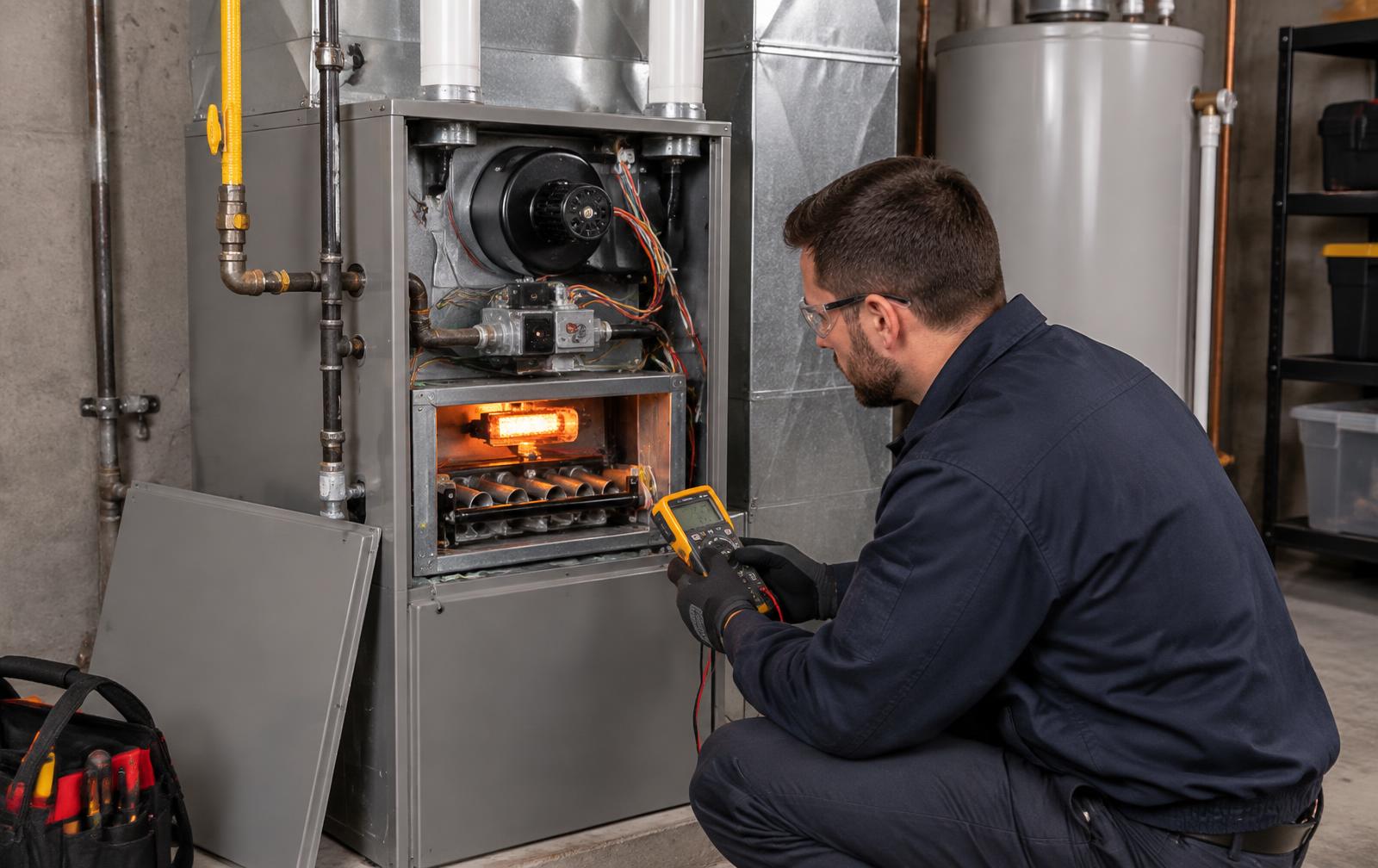
A glowing furnace igniter confirms that part of the startup sequence occurred, but it does not prove that gas reached the burners or that the furnace established a safe flame. Gas supply, gas-valve operation, burner condition, control signals and safety circuits may all be involved. Do not touch the hot igniter, bypass a safety control or repeatedly reset the furnace.
The glow is a useful observation because it narrows where the sequence stopped. It is not enough to identify a failed part from across the room. This guide explains the difference between an igniter that never heats, burners that never light, and burners that light briefly before shutting down. It also separates safe observations from work that belongs to a licensed heating technician.
What a glowing furnace igniter confirms
Most newer gas furnaces use a hot-surface igniter. During a call for heat, the control board supplies power to this small ceramic element until it becomes bright orange. Seeing that glow generally confirms that the thermostat has requested heat, the control board has advanced through at least part of its sequence, and the inducer and pressure-switch circuit may have satisfied the conditions required before ignition.
It does not confirm that the gas valve opened, that fuel pressure is correct, that the burner ports can carry flame, or that the control board kept the valve energized. It also does not prove that the igniter is positioned correctly or hot enough under load. A weakened igniter can glow visibly yet fail to reach the temperature or electrical characteristics required by that furnace model.
For the broader diagnosis beyond this symptom, see what can cause a furnace to stop working; the visible FAQ separates safe observations from technician-only checks.
City homes can review residential furnace repair in Chicago.
If you live inside Chicago city limits, our Chicago furnace repair page covers city homes and the 773 line.
The normal furnace ignition sequence
A modern furnace starts in a deliberate order. The thermostat sends a heat call. The control board checks its safety circuit and starts the inducer motor to establish draft through the heat exchanger and vent. A pressure switch confirms that draft. The igniter then heats, the gas valve is energized, gas reaches the burners, and flame travels across the burner assembly. A flame sensor proves that combustion is present before the main blower starts moving warm air through the house.
If any required signal is missing, the board stops or delays the sequence. Some furnaces make another controlled ignition attempt; others enter a lockout and display a fault code. That behavior protects the equipment and the building. Repeatedly cycling power can erase useful fault history and is not a substitute for finding the step that failed.
If the thermostat never begins a heat call, start with our information about thermostat and heating-control repair.
Why the igniter can glow while the burners never light
When the igniter glows and the burners remain dark, the failure occurred around the point where the gas valve should open and flame should establish. Possible causes include an interrupted gas supply, a gas valve that is not opening, insufficient voltage at the valve, a control board that is not sending or maintaining the command, a safety circuit that opens during the trial, burner contamination, or an igniter that is glowing but no longer operating correctly.
Those possibilities overlap from a homeowner's point of view. Listening for a click can be useful information, but a click does not prove that the valve opened or that gas flowed. The absence of a click does not identify the board by itself. Voltage, gas pressure, ignition timing, safety status and the manufacturer's sequence all have to be compared before a part is condemned.
Gas-supply or gas-valve problems
A closed upstream valve, utility interruption, regulator issue, low inlet pressure, failed gas valve or missing control voltage can keep fuel from reaching the burners. A valve can also receive a command but fail mechanically. Gas-system testing requires approved instruments and knowledge of the equipment specifications; it is not a homeowner repair and should never be tested by loosening fittings or trying to force the valve open.
Dirty, restricted or misaligned burners
Rust, scale, dust or debris can interfere with burner ports and the crossover path that carries flame from the first burner to the others. A burner shifted out of position can also place the igniter outside the intended ignition area. These conditions can cause failed ignition, delayed ignition or uneven flame. Burner removal, cleaning and alignment affect combustion and should be handled professionally rather than brushed or repositioned through an access opening.
Control-board, wiring and safety-circuit problems
A loose connector, damaged wire, failing relay, incorrect polarity, grounding problem or safety switch opening at the wrong moment can interrupt the command to the gas valve. The board may be responding correctly to another unsafe condition rather than failing itself. A proper diagnosis checks the whole circuit and reads stored fault information before replacing controls.
Burners that never light versus burners that light and shut down
These are different symptoms. If the igniter glows but no flame appears at all, diagnosis centers on the trial-for-ignition stage: gas availability, valve command and operation, igniter performance and position, burners, wiring and safeties. If flame appears across the burners and then disappears after a few seconds, the furnace did establish ignition but did not prove or maintain it.
A brief flame followed by shutdown often shifts attention toward flame sensing, grounding, flame quality, gas pressure or a safety input. Video recorded from a safe distance through an existing observation opening can help show which pattern occurred. Do not remove panels, reach inside or defeat a door switch to watch the sequence.
Igniter problem versus flame-sensor problem
The igniter starts combustion; the flame sensor confirms that combustion continued. A cracked igniter commonly stays dark, works intermittently or fails an electrical test. However, an aging igniter may still glow and not perform within the furnace manufacturer's specified range, so appearance alone is not conclusive.
A contaminated or poorly grounded flame sensor becomes relevant after the burners light. If the burners never produce flame, cleaning or replacing a flame sensor will not create a missing gas-valve command. If they light normally and then shut down within seconds, flame-proving becomes a stronger possibility. The distinction prevents unrelated parts from being replaced and is one reason our furnace repair process follows the complete sequence.
For diagnosis of either symptom, see our furnace repair and no-heat service.
If the attempt comes with a boom, rattle or squeal, our guide to a furnace making noise covers what those sounds usually mean.
Older furnaces with standing pilot lights
An older furnace with a standing pilot does not use the same hot-surface ignition sequence. Its small pilot flame remains lit and ignites the main burners when the gas valve receives a heat call. If that pilot will not stay lit, the problem may involve the pilot flame, thermocouple or thermopile, draft, gas pressure, venting or the gas control.
Do not apply hot-surface-igniter advice to standing-pilot equipment. Follow only the lighting directions attached to that exact furnace, and stop if they are missing, illegible or the pilot repeatedly goes out. A yellow, irregular or unstable pilot and any soot around the burner area require professional attention.
Safe observations without opening or repairing equipment
Useful information can be gathered without tools and without entering the burner compartment. Note what the thermostat displays, whether the inducer starts, whether the igniter glows, whether flame ever appears, how long each step lasts, and whether the blower eventually runs. Record any fault code visible through the manufacturer's sight glass and keep the furnace doors in place.
- Confirm the thermostat is set to HEAT and above room temperature
- Check whether other gas appliances appear to have service, without using them to test for a leak
- Look for an external utility notice or an obviously closed furnace service switch
- Check the filter only through its normal accessible slot and replace it if visibly blocked
- Write down the furnace model, the visible fault code and the order of sounds or lights
- Stop after one observed failed cycle; do not keep resetting power to repeat it
Homeowners evaluating the broader system can review all heating services, while buyers and property managers can request a documented
When to stop operating the furnace
Leave the furnace off and request diagnosis when ignition repeatedly fails, the equipment locks out, ignition is delayed with a bang or rumble, flame appears outside the burner openings, soot is visible, wiring looks scorched, or you smell burning. A carbon-monoxide alarm, headache, dizziness, nausea or confusion requires everyone to leave the building and call 911 from outside.
Never bypass the pressure switch, rollout switch, limit, door switch or flame sensor. Never hold a gas valve open, move the igniter toward the burner, or use a match or lighter to ignite modern furnace burners. These controls and clearances exist to keep gas from flowing when the furnace cannot establish safe combustion.
What to do if you smell gas
If you smell gas, do not operate light switches, thermostats, phones, appliances or garage-door controls inside. Do not search for the source and do not try another heating cycle. Get everyone and any pets out immediately, move away from the building, and call 911 and the gas utility from a safe location. Return only when emergency responders or the utility say it is safe.
A heating service appointment comes after the immediate leak concern has been made safe. Tell the dispatcher that gas was smelled and what the utility or fire department found so the technician arrives with the correct context.
What professional furnace diagnosis includes
A technician begins with the reported sequence and the control board's active and stored fault codes. The heat call, inducer operation, pressure-switch response and igniter timing are verified. During the ignition trial, electrical measurements determine whether the gas valve received the proper command, while approved instruments determine whether inlet and manifold gas pressure meet the equipment specifications.
The technician also examines igniter condition and placement, burner cleanliness and alignment, flame carryover, grounding, wiring, venting, combustion air and the heat exchanger. Safety controls are tested rather than bypassed. If the burners light and drop out, flame-sensor current and flame quality become part of the test. This process identifies whether the board is withholding gas for a valid reason or whether a component actually failed.
Right Away Plumbing & HVAC is licensed, bonded and insured. We explain the measured failure and the available correction before work begins, rather than treating a visible glow as proof that one particular part must be replaced.
Repair versus replacement without sales pressure
A failed igniter, damaged wire, burner service need or individual control fault can often be repaired on an otherwise sound furnace. Replacement becomes a separate discussion when the heat exchanger is unsafe, corrosion or damage is extensive, compatible parts are unavailable, or an older system has developed repeated significant ignition and control failures.
Age alone does not make the decision, and one failed ignition cycle does not prove the furnace is finished. A useful comparison considers the diagnosed repair, overall equipment condition, repair history, comfort, venting, airflow and whether the existing furnace is correctly sized. If replacement is worth considering, the options should be priced and explained without pressure.
Our furnace installation and replacement page explains sizing, airflow and startup testing.
Chicago-area furnace service
Right Away Plumbing & HVAC diagnoses ignition failures in Chicago, Des Plaines and nearby suburbs from our office at 2093 Rand Rd, Des Plaines, IL 60016. Chicago addresses call 773-250-6060. Des Plaines and suburban addresses call 847-550-3322. The purpose of the visit is to identify where the ignition sequence stopped and restore operation only when the furnace can run safely.
Review local service information for Chicago or
Des Plaines, browse all
service areas, or use the
contact page to request professional furnace diagnosis.
Frequently asked questions
Why does my furnace igniter glow without lighting the burners?
The furnace reached the igniter stage but did not establish flame. Possible causes include interrupted gas supply, a gas valve that did not open, missing control voltage, a safety circuit opening, restricted or misaligned burners, wiring or control-board faults, or an igniter that glows but no longer performs to specification. Testing is required before one part is blamed.
Why do the burners light and then shut down after a few seconds?
That pattern means ignition occurred but the furnace did not prove or maintain safe flame. A contaminated flame sensor is common, but poor grounding, weak flame, gas-pressure problems, wiring or another safety input can cause the same shutdown. The flame-proving circuit and combustion should be tested before parts are replaced.
How can I tell whether the problem is the igniter, gas valve or flame sensor?
The sequence gives clues but not a complete diagnosis. An igniter that never glows differs from one that glows with no flame; a flame sensor becomes relevant only after burners light. A technician must test igniter performance, gas-valve command and pressure, burner condition, wiring and flame-sensor current to identify the failed step safely.
Should I keep resetting the furnace when it fails to ignite?
No. Repeated resets can erase useful fault history and keep asking a gas appliance to attempt a sequence that has already failed. Leave the furnace off after a repeated failure or lockout and request professional diagnosis. Never bypass a safety control to force another attempt.
What should I do if I smell gas near the furnace?
Do not operate switches, thermostats, phones, appliances or garage-door controls inside. Do not search for the source. Get everyone and any pets outside, move away from the building, and call 911 and the gas utility from a safe location. Return only when emergency responders or the utility say it is safe.
Should I repair or replace an older furnace with repeated ignition problems?
Base the decision on the diagnosed fault, heat-exchanger and overall equipment condition, repair history, parts availability, venting, airflow and sizing—not age or one symptom alone. Many individual ignition faults are repairable. Replacement deserves consideration when safety damage is present or significant failures keep recurring, with both options explained without sales pressure.
Talk to Right Away
A glowing igniter is useful evidence, but it is only one point in a controlled safety sequence. Leave the furnace off after repeated failed ignition, and never bypass a safety or attempt gas-valve or burner work yourself.
Call 773-250-6060 for Chicago or 847-550-3322 for Des Plaines and nearby suburbs to schedule furnace diagnosis with Right Away Plumbing & HVAC.
You can read more about our plumbing services, check the communities we serve, or start with plumbing in Des Plaines and Park Ridge. Planning a remodel or weighing a big replacement? Our consulting service is built for that conversation.