
Navien Tankless Water Heaters, Boilers and Combi-Boilers for Chicago-Area Homes
· 12 min read · Right Away Plumbing and HVAC
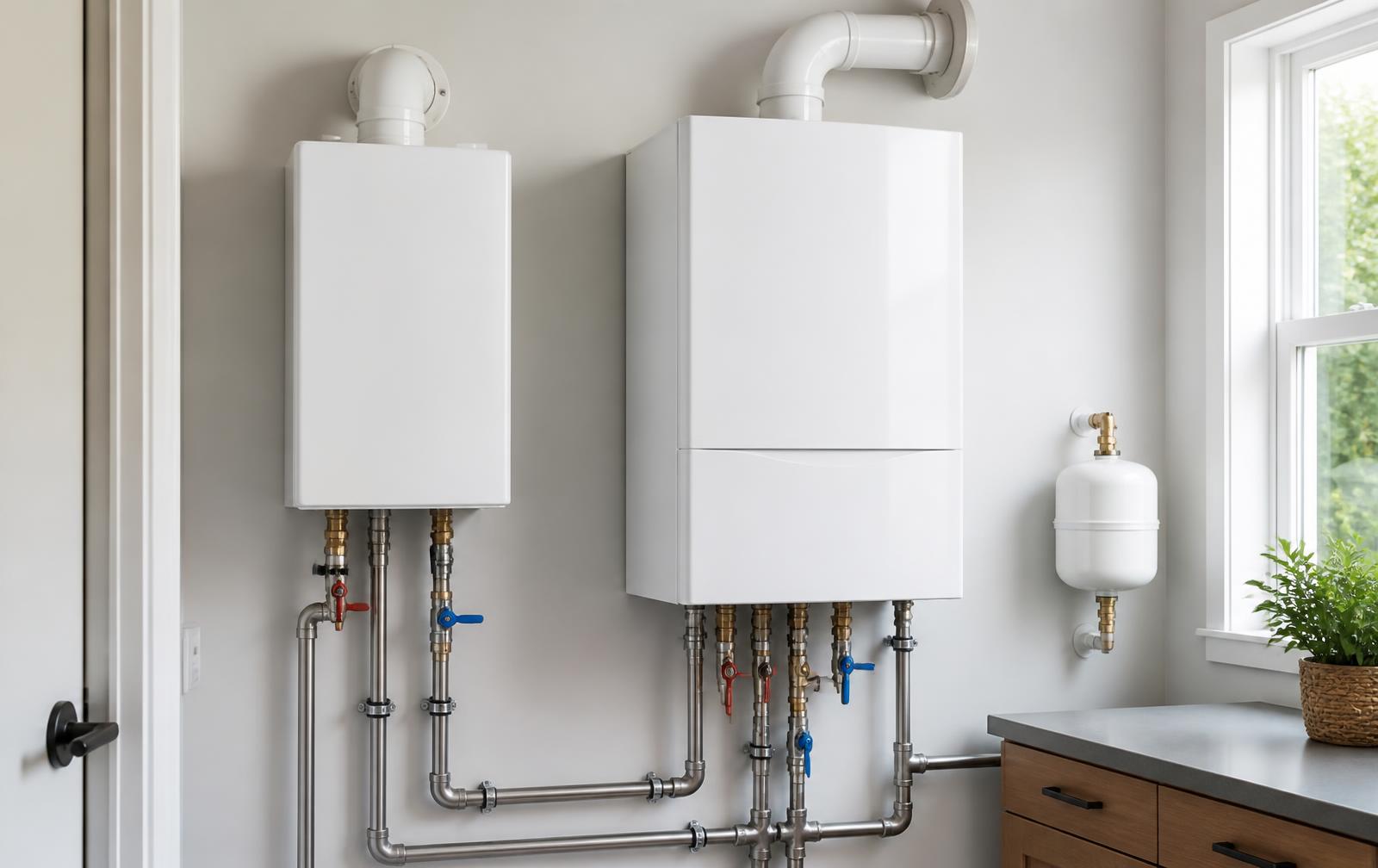
Navien equipment gets grouped together in conversation, but the products do different jobs. A tankless water heater supplies domestic hot water — the water at your showers, sinks, tub and laundry. A boiler supplies space heating, moving hot water through radiators, baseboard or in-floor tubing. A combi-boiler combines both functions in one compact wall-mounted system, providing heating and domestic hot water from a single appliance.
That distinction decides almost everything else: the sizing math, the gas and venting work, what maintenance looks like, and what happens when something goes wrong. This guide explains the differences in plain language for Chicago-area homes, and describes how we approach installation, conversion, maintenance and repair from our shop in Des Plaines.
Tankless water heater, boiler or combi-boiler: what each one does
A condensing tankless water heater heats water on demand as it flows through a heat exchanger. There is no storage tank keeping water hot around the clock, so the unit fires only when a fixture calls for hot water. Capacity is expressed as a flow rate at a given temperature rise, which matters a great deal here because incoming water is cold in a Chicago winter.
A boiler is a heating appliance. It heats water and circulates it through a hydronic distribution system — cast-iron radiators in an older Chicago bungalow, fin-tube baseboard in a post-war suburban home, or radiant tubing in a newer build or an addition. It is sized from the building's heat loss, not from how many showers run at once.
A combi-boiler does both. One wall-hung unit heats the home and produces domestic hot water, usually prioritizing the hot-water call over the heating call for the minute or two the tap is open. Combi units are popular where mechanical-room space is tight, but they have to be selected carefully: the same appliance must satisfy the building's heat loss and the household's simultaneous hot-water demand.
For planned care rather than an active fault, review boiler maintenance in Chicago and report leaks or recurring shutdowns when booking.
If replacement is being considered after diagnosis, see what affects boiler replacement cost in Chicago before comparing written scopes; no single price fits every system.
Our main Navien page covers equipment, service and sales in more detail: Navien installation and service.
Where the Navien lineup fits
Navien's condensing tankless water heaters — the NPE-A2 and NPE-S2 families — are domestic hot water appliances. The A2 series includes integrated recirculation features that suit homes with long runs to a distant bathroom; the S2 series is a straightforward condensing tankless unit where an external recirculation strategy or none at all is appropriate.
On the hydronic side, the NFB-H and NHB-H are boilers: heating appliances for radiators, baseboard or radiant. The NCB-H and NFC-H are combi-boilers, handling space heating and domestic hot water in a single wall-hung cabinet. Which family fits depends on the building's distribution system, its heat loss, and how much hot water the household actually uses at once.
Around that equipment sit the controls and accessories. NaviLink connectivity allows setpoint monitoring and adjustment from a phone and can make service conversations more precise. Recirculation options — internal on some models, external pump-and-return arrangements on others — address wait times at distant fixtures. Compatible Navien water-treatment products address water quality, which directly affects heat-exchanger life in the hard water common across Chicagoland.
This is not a model catalog, and the right answer is rarely the largest unit. Equipment selection follows the calculations, not the other way around.
For tankless installation, replacement and repair specifically, see our tankless water heater services page.
Manufacturer-qualified specifications worth knowing
The numbers below are manufacturer-published ratings for condensing equipment, tested under laboratory conditions. Real-world performance depends on sizing, installation, controls, water quality, the building and how the system is used.
- Condensing tankless water heaters rated up to .96 UEF, depending on model and configuration
- Boilers and combi-boilers rated up to 95% AFUE, depending on model
- Stainless-steel heat exchangers used across the condensing tankless and hydronic lines
- Compact wall-hung cabinets that free floor space in tight mechanical rooms and closets
- Boiler turndown ratios up to 15:1, allowing the unit to modulate down on mild days instead of cycling at full fire
What correct selection actually requires
Choosing equipment from a brochure is where most disappointing installations begin. A proper selection is an engineering exercise, and every one of the following inputs can change the answer:
- Simultaneous hot-water demand — how many fixtures realistically run at the same time, and at what flow rate
- Winter incoming-water temperature, which sets the temperature rise a tankless unit must deliver in January, not in July
- A building heat-loss calculation for any boiler or combi-boiler, based on the actual structure rather than square footage rules of thumb
- Gas capacity — meter size, pipe size and length, and the load of every other gas appliance in the building
- Venting — material, length, termination clearances and whether the existing chimney or sidewall arrangement can be used
- Condensate drainage and neutralization, including where the condensate can legally and practically go
- Electrical supply for the appliance and any pumps or controls
- Water quality, since hardness and sediment drive heat-exchanger scaling and service intervals
- Available space, service clearances and how the unit will be reached for maintenance
- Local code review and permitting, which differs between Chicago and the surrounding suburbs
If you want that review before spending money on equipment, our consulting service is built for exactly that conversation — heating, hot water and distribution looked at together.
Installation and tank-to-tankless conversion
Replacing a storage tank with a condensing tankless unit is rarely a straight swap. The gas supply frequently needs to be verified or upsized, new venting has to be routed and terminated correctly, condensate drainage must be provided, isolation valves belong on the unit so it can be serviced, and the electrical supply has to be in place.
Done properly, the result is a wall-hung unit with no standby tank losses and hot water that does not run out; done carelessly, it becomes a unit that nuisance-faults and is impossible to service.
Boiler and combi-boiler replacements carry the same discipline plus the hydronic side: near-boiler piping, circulator selection, air and dirt separation, expansion, zoning and controls. Older Chicago-area systems are often converted from oversized cast-iron boilers, and the new equipment only delivers its rated efficiency if the distribution system and controls let it modulate and condense.
For replacement planning on the hydronic side, see boiler installation and replacement.
Maintenance, descaling and water quality
Annual service is the single biggest factor in how long this equipment lasts. On a tankless water heater, that means descaling the heat exchanger through the isolation valves, cleaning or replacing the inlet filter, inspecting the burner and venting, checking combustion and reviewing stored fault history. Chicago-area water is hard enough that skipping descaling shows up as reduced flow, temperature swings and eventually error codes.
Water treatment is part of the maintenance conversation rather than an upsell. Reducing hardness and sediment before the appliance slows scale formation in the heat exchanger and protects fixtures and other water-using appliances at the same time. Equipment should be matched to what a water test actually shows, not chosen generically.
Boilers and combi-boilers need their own annual attention: combustion testing, condensate trap and neutralizer service, system pressure and expansion checks, relief-valve inspection, circulator and air-separation checks, and cleaning of the heat exchanger where the manufacturer calls for it.
Water quality has its own page — see whole-house water filtration and treatment.
Common symptoms and error-code diagnosis
A displayed error code is a starting point, not a diagnosis. The code narrows the area; testing identifies the cause. Clearing a code without finding what triggered it usually means the same fault returns, sometimes with additional damage.
- Ignition problems — gas supply or pressure, ignition components, venting restriction, flame proving or control faults
- Scale buildup — reduced flow, longer heat-up, noise in the heat exchanger and efficiency loss
- Insufficient hot water — undersized equipment for winter temperature rise, scaling, a fouled filter or a distribution issue
- Fluctuating water temperature — flow below the activation threshold, mixing-valve problems, recirculation set up incorrectly or scaling
- Cold radiators or uneven heat — air in the system, circulator or zone-valve faults, distribution balance or control problems
- Boiler short cycling — oversizing, incorrect control settings, low flow through the heat exchanger or a limit tripping early
If the heat is the problem rather than the hot water, start with boiler repair and no-heat service.
Our full heating service list is on the heating services page.
Repair or replace, residential or commercial
Repair usually makes sense when the unit was correctly sized and installed, maintenance has been kept up, parts remain available and the failure is a discrete component. Replacement becomes the honest recommendation when the appliance was wrong for the building from the start, when the heat exchanger is compromised, when repeated faults trace back to an installation problem that cannot be corrected economically, or when repair costs begin approaching the cost of correct new equipment.
We give you the findings and the numbers and let you decide; there is no sales pressure attached to a diagnosis.
The same equipment families appear in light commercial work — small multi-unit buildings, salons, restaurants and offices — where simultaneous demand and recovery matter even more than they do in a single-family home. Commercial selection follows the same calculations, with cascade or multi-unit arrangements where a single appliance cannot cover the load.
What we are certified for, and what we are not claiming
Right Away Plumbing & HVAC is certified specifically for Navien tankless water heater installation, service and maintenance. That certification is limited to tankless water heaters and we do not extend it to the rest of the lineup.
Navien boilers, combi-boilers and other Navien equipment are installed and serviced by our licensed plumbing and HVAC technicians following the manufacturer's published specifications. We are licensed, bonded and insured, and we work from 2093 Rand Rd, Des Plaines, IL 60016.
Warranties vary by product, application, installation and maintenance. The applicable written Navien warranty governs coverage on the equipment, so review it for your specific unit — we do not promise coverage on your behalf. Qualifying installations may include our lifetime product, labor and parts warranty program; terms and eligibility apply.
Frequently asked questions
Is a Navien tankless water heater the same as a combi-boiler?
No. A tankless water heater supplies domestic hot water only — showers, sinks, tub and laundry. A combi-boiler supplies space heating for radiators, baseboard or radiant tubing and also produces domestic hot water from the same wall-hung unit. They are different appliances, sized from different calculations, and one cannot simply be substituted for the other.
Can one Navien combi-boiler heat the house and provide hot water?
Yes, that is what a combi-boiler is designed to do, provided it is selected correctly. The unit must satisfy the building's heat-loss calculation and the household's realistic simultaneous hot-water demand at winter incoming-water temperatures. Homes with several bathrooms in use at once sometimes need a different arrangement, so the calculations come before the equipment choice.
How often should a Navien tankless water heater be descaled?
About once a year for most Chicago-area homes, and more often for heavy-use or commercial installations and for buildings with especially hard water. Descaling is performed through the isolation valves and is usually combined with filter cleaning, burner and venting inspection and a review of stored fault history. Manufacturers generally tie warranty coverage to documented maintenance.
Can you service a Navien system installed by another contractor?
In most cases, yes. We diagnose the fault, verify that the installation meets the manufacturer's specifications for gas, venting, condensate and water treatment, and quote the repair before work begins. If we find an installation problem, we show you what is wrong and what correcting it involves rather than repeatedly replacing parts.
Why does my Navien unit display an error code?
A code indicates that the control detected a condition outside its programmed limits — commonly related to ignition, gas supply or pressure, venting or air supply, water flow, scale in the heat exchanger, condensate drainage or a sensor. The code narrows the area to test; it does not identify the failed part on its own. Clearing a code without diagnosing the cause generally means it returns.
Do I need a larger gas line?
Sometimes. Condensing tankless water heaters and combi-boilers can have a higher input rate than the appliance they replace, and the existing pipe size, length, meter capacity and the load of the other gas appliances all factor in. We calculate the gas load and verify pressure before installation rather than assuming the existing line is adequate.
Can hard water damage a tankless heat exchanger?
Hard water causes scale to form on heat-exchanger surfaces, which reduces flow and efficiency, causes temperature swings and noise, and can eventually lead to faults and shortened equipment life. Annual descaling and appropriate water treatment are the practical defenses, matched to what a water test on your property actually shows.
Should I repair or replace my Navien unit?
Repair usually makes sense when the equipment was properly sized and installed, maintenance has been kept up, and the failure is a discrete component with parts available. Replacement is the honest answer when the appliance was wrong for the building, when the heat exchanger is compromised, or when repeated faults trace back to an installation problem that cannot be economically corrected. We provide the findings and the costs and let you choose.
What Navien warranty applies to my equipment?
Warranties vary by product, application, installation and maintenance, so the applicable written Navien warranty for your specific model and installation governs coverage. Review that document and keep records of annual maintenance, which manufacturers commonly require. We do not promise coverage on the manufacturer's behalf. Qualifying installations may include our lifetime product, labor and parts warranty program; terms and eligibility apply.
Talk to Right Away
Whether you need a tankless water heater sized for a Chicago winter, a boiler or combi-boiler replacement planned properly, annual descaling, or an error code diagnosed, our licensed technicians can help. Call 847-550-3322 for Des Plaines and the suburbs, or 773-250-6060 in Chicago.
Right Away Plumbing & HVAC, 2093 Rand Rd, Des Plaines, IL 60016 — licensed, bonded and insured.
You can read more about our plumbing services, check the communities we serve, or start with plumbing in Des Plaines and Park Ridge. Planning a remodel or weighing a big replacement? Our consulting service is built for that conversation.
For installation, repair, descaling or sizing on a tankless system, see our tankless water heater services page.
Service areas for this work include Des Plaines and Chicago. Questions about your building? Use our contact page.