Common Tankless Water Heater Error Codes and When to Call for Repair
· 8 min read · Right Away Plumbing and HVAC
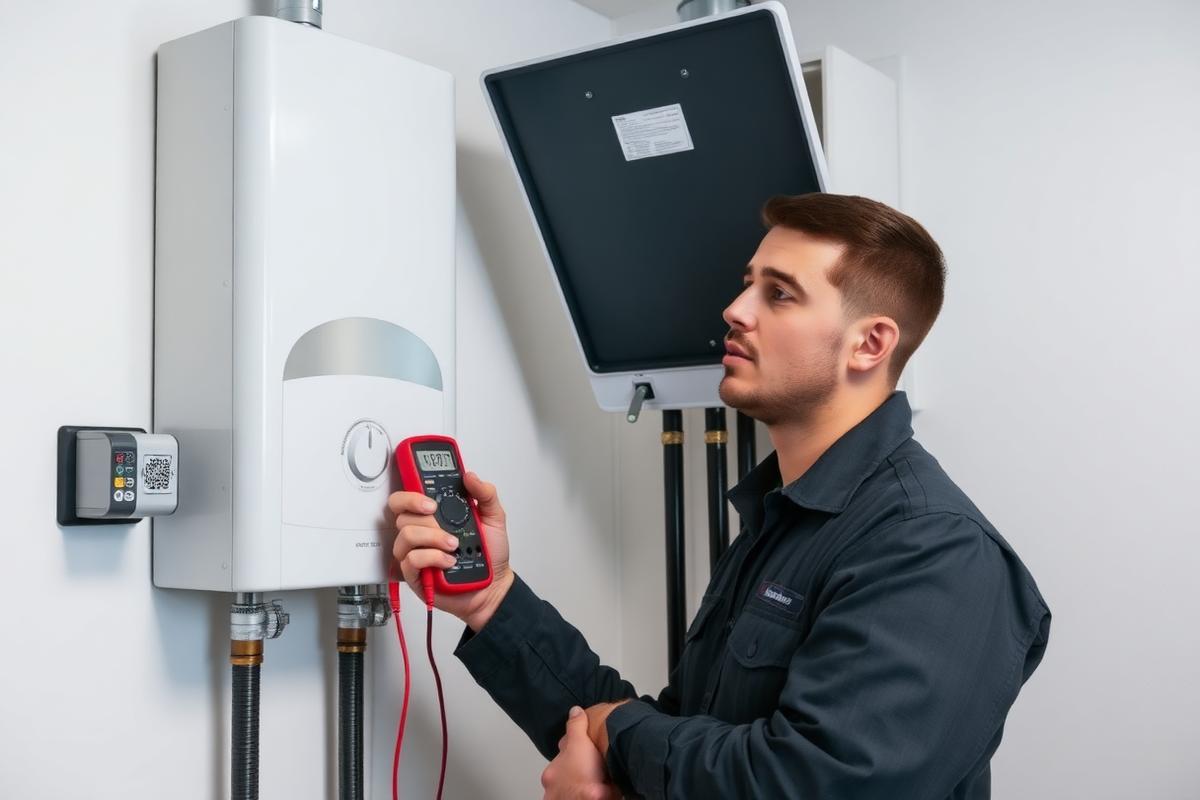
One of the genuinely useful things about a tankless water heater is that it tells you when something is wrong. Instead of quietly underperforming, it displays a code and, in most cases, stops. That is the unit protecting itself.
Code numbers differ by manufacturer, so the exact code on your panel should be looked up in your unit's manual. What does carry across brands is the category of fault behind the code. Below are the families we see most often on service calls around Des Plaines and Chicago, what each usually points to, and where the line is between a homeowner check and a call.
Ignition and flame failure codes
These appear when the unit tries to light and either fails to ignite or cannot confirm a flame. Common causes are a closed or partially closed gas valve, an interrupted gas supply, low gas pressure under load, a dirty flame sensor, a worn igniter, or air in the gas line after service elsewhere in the house.
Homeowner check: confirm the gas is on and that other gas appliances are working. If the furnace and range are fine and the heater still will not light, stop there — repeated ignition retries are not something to keep forcing.
Venting, air supply and exhaust codes
Tankless units monitor combustion airflow closely, and a code in this family means the unit is not getting the intake air or exhaust path it needs. Causes include a blocked intake or exhaust termination, ice or snow at the vent outlet in winter, nesting or debris, a disconnected or sagging vent section, or a blower fault.
Homeowner check: go outside and look at the vent terminations. Clearing snow drifted against them is reasonable and is a real winter cause here. Anything involving the vent piping itself is a call — this family of codes is the one most directly tied to combustion safety.
Overheat, scale and heat exchanger codes
These indicate the unit measured a temperature it should not have seen. Scale in the heat exchanger is a leading cause, because mineral buildup insulates the metal from the water and creates hot spots. Restricted flow from a clogged inlet filter, a partially closed valve or a failing circulation pump produces the same symptom.
This family is the strongest argument for annual descaling. Once these codes start appearing, the exchanger has usually been running hot for a while.
Descaling is the maintenance that resolves most of these before they turn into equipment failures — we cover it in our guide to Navien tankless maintenance and descaling in Chicagoland.
Flow sensor and water supply codes
Tankless units only fire when they detect flow. Codes here often mean the unit is not seeing the flow it expects: a clogged inlet screen, a stuck flow sensor, a partially closed service valve after a repair, low incoming water pressure, or a whole-house filter that is overdue for a cartridge change.
Homeowner check: verify that both isolation valves are fully open and that other fixtures have normal pressure. Changing a neglected whole-house filter cartridge is fair game. Cleaning the unit's inlet screen is a service task.
Gas pressure codes
A burner that fires hard needs adequate gas volume. Codes in this family show up in homes where the line feeding the unit is undersized, where several gas appliances run at once on a marginal supply, or where a regulator is failing. These are frequently installation-era problems that only reveal themselves on the coldest days, when the furnace and the water heater both want maximum input.
This is not a reset-and-hope situation. Gas supply issues get diagnosed with a manometer under load.
Condensate and freeze protection codes
Condensing tankless units produce acidic condensate that has to drain freely, usually through a neutralizer. A plugged trap, a frozen condensate line in an unheated space, or a spent neutralizer cartridge can all fault the unit. Freeze protection codes also appear when a unit installed in a garage or an unheated area lost power during a cold snap.
Homeowner check: look for standing water, a blocked drain line or a disconnected hose. Keep the unit powered through winter so its built-in freeze protection can operate.
When to reset and when to call
Resetting once is reasonable. A code can be triggered by a one-time event — a brief gas interruption, air in the line after unrelated work, a momentary power blip.
- Call if the same code returns after one reset
- Call immediately for any smell of gas, and leave the building first
- Call for anything involving the vent, exhaust or combustion air
- Call for repeated overheat or exchanger codes, which usually mean scale
- Call if the unit is under warranty, since documented professional service protects coverage
- Call if you have no hot water and the code will not clear
Is an error code a sign the unit needs replacing?
Usually not. Most codes come back to scale, venting, gas supply, ignition components or a sensor, and all of those are serviceable. Replacement enters the conversation when the heat exchanger itself has failed on an older unit, when parts are no longer available, or when repair costs have started stacking up on equipment that was undersized from the beginning.
We diagnose the fault first and give you both numbers — repair and replacement — so the decision is yours with real information behind it.
If your unit is showing a code you cannot clear, our tankless water heater repair and service page explains how we diagnose it and what to expect. You can also review our full range of plumbing work if the problem turns out to be elsewhere in the system.
Frequently asked questions
Is it safe to keep resetting a tankless water heater?
Reset once. If the same code returns, the unit is reporting a real condition and repeated resets just delay the diagnosis. Never keep resetting an ignition or venting fault.
Why does my tankless heater only fault in winter?
Cold incoming water raises the burner load, snow and ice can block vent terminations, and condensate lines in unheated spaces can freeze. Winter-only faults usually point to one of those three.
Can descaling clear an error code?
It often clears overheat and exchanger-related codes, since scale is the usual cause. It will not fix an ignition, venting or gas pressure fault.
Do you repair Navien tankless water heaters?
Yes. We are certified for Navien tankless water heater installation, service and maintenance, and we diagnose and repair other major tankless brands as well.
Talk to Right Away
A code on the panel is information, not a verdict. Right Away Plumbing and HVAC diagnoses tankless faults, quotes the repair before starting, and tells you honestly when a unit is worth keeping. We serve Des Plaines, Chicago and the surrounding Chicagoland communities.
You can read more about our plumbing services, check the communities we serve, or start with plumbing in Des Plaines and Park Ridge. Planning a remodel or weighing a big replacement? Our consulting service is built for that conversation.
For installation, repair, descaling or sizing on a tankless system, see our tankless water heater services page.