No Heat in a Chicago Winter? What to Check First, and When to Call for Emergency Boiler or Furnace Repair
· 9 min read · Right Away Plumbing and HVAC
The heat almost never goes out on a mild afternoon. It goes out at night, during the first real cold snap, when the system is running harder than it has in months. In Chicago, a house without heat can drop fast, and pipes in exterior walls are at risk within hours when temperatures fall well below freezing.
The good news is that a fair number of no-heat calls come down to something simple: a thermostat setting, a tripped switch, a clogged filter or a low boiler. This guide walks through the safe checks any homeowner can make, the safety warnings that override everything else, and when it is time to call for emergency boiler or furnace repair.
Safety first: gas and carbon monoxide
If you smell gas, do not touch light switches or the thermostat. Leave the building and call the gas utility or 911 from outside. If a carbon monoxide alarm goes off, or anyone in the home has a headache, dizziness, nausea or confusion that gets better outside, get everyone out and call 911.
Never use a gas oven or range to heat the house, and never run a generator or grill indoors or in an attached garage. Every home with gas heat should have working carbon monoxide alarms on each level and near bedrooms. If yours are older than their labeled replacement date, replace them before winter.
For the broader diagnosis beyond this symptom, see what can cause a furnace to stop working; the visible FAQ separates safe observations from technician-only checks.
City homes can review residential furnace repair in Chicago.
For furnace, boiler or heat-pump faults, start with heating repair in Chicago.
Check 1: the thermostat
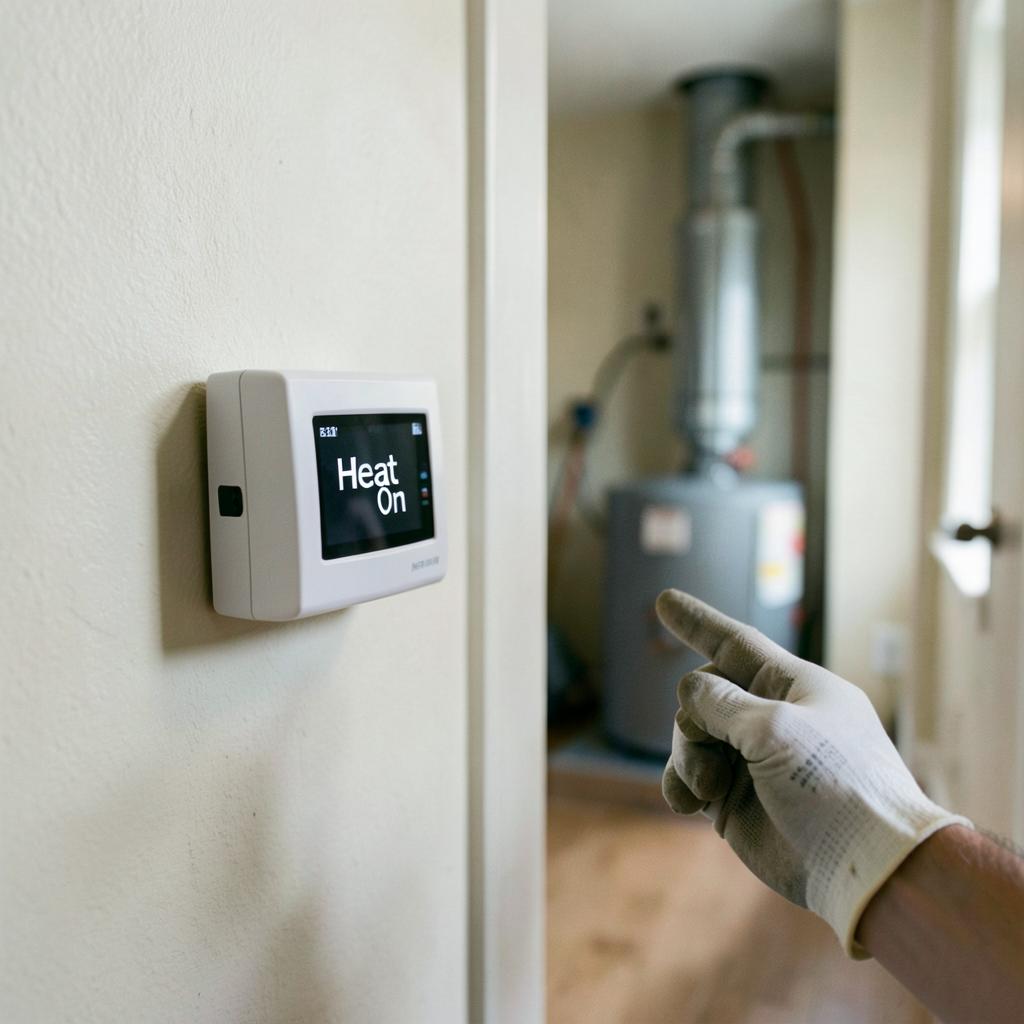
Make sure the thermostat is set to Heat, not Cool or Off, and set several degrees above the current room temperature. If it uses batteries, replace them — a weak battery can leave the display on but stop the call for heat. Smart thermostats can lose Wi-Fi or a schedule; check that a schedule or away mode is not holding the temperature down.
If the thermostat says heat is on but nothing happens, read thermostat says heat on but no heat.
Check 2: power, breaker and service switch
Boilers and furnaces need electricity even when they burn gas. Check the breaker panel for a tripped heating breaker and reset it once. Then find the service switch near the equipment — it often looks like an ordinary light switch on the wall or ceiling near the boiler or furnace, sometimes with a red cover plate. It is easy for someone to flip it off by mistake.
If the breaker trips again right away, leave it off and call. A breaker that keeps tripping is a sign of an electrical fault in the equipment.
Check 3 (furnaces): the filter, door and vents
A badly clogged filter starves the furnace of air, which can overheat it and trip a safety switch. Pull the filter and look at it; if it is gray and packed, replace it. Make sure the blower compartment door is fully seated — most furnaces have a door switch that keeps them off when the panel is loose.
High-efficiency furnaces vent through white PVC pipes on an outside wall. After a heavy snow or drifting, check that those pipes are not buried or blocked by ice. Clear them gently by hand. Also look for water around the furnace, which can point to a clogged condensate drain — a common cause of short cycling and lockouts.
Read about a clogged furnace condensate drain and what it does to a furnace.
Check 4 (boilers): water level and pressure
On a steam boiler, look at the glass sight tube on the side of the boiler. Water should be visible around the middle. If it is empty, the low-water cutoff has likely shut the boiler down to protect it. Do not add water to a hot, empty steam boiler — let it cool and call for service, because adding cold water to a hot boiler can crack it.
On a hot-water boiler, check the pressure gauge. Many residential systems run roughly between 12 and 20 psi when cold, but your boiler's label or manual is the authority. A gauge near zero suggests a leak or failed fill valve; a gauge near the relief valve setting suggests an expansion tank problem. Either way, a technician should find the cause.
For radiators that stay cold while the boiler runs, see boiler running but radiators cold.
Check 5: one reset, not five
Many boilers and furnaces have a reset button or will retry after power is cycled. One reset is reasonable. If the system locks out again, stop. Repeated resets can mask a safety problem, and on some older equipment they can let unburned fuel build up. Note any blinking light pattern or error code before you call — it helps narrow down the fault.
When to call for emergency boiler or furnace repair
Call if the system still will not heat after the checks above, if a breaker keeps tripping, if the boiler is out of water or leaking, if the furnace starts and shuts down repeatedly, or if you hear loud bangs, smell burning or see scorch marks. Call immediately for anything involving gas smell or a CO alarm — after you are safely outside and emergency services have been contacted.
When you call, tell us whether it is a boiler or furnace, what it does when the thermostat calls, any error code, whether all rooms or only some are cold, and what type of building it is. That decides which parts the truck carries.
See our emergency no-heat service page for how we handle these calls, or go straight to
Keep the pipes from freezing while you wait
Open cabinet doors under sinks on outside walls, let the faucets on the most exposed lines drip, and keep interior doors open. If you have a safe, listed electric space heater, keep it away from anything that can burn and never leave it unattended. If a pipe freezes, do not use an open flame to thaw it.
If a pipe freezes or bursts, see frozen pipe repair.
Prevent the next no-heat night
Most mid-winter failures give warning signs in the fall: a slow igniter, a flame sensor that drops out, a boiler that floods its sight glass. A pre-winter tune-up is the best way to catch them on your schedule instead of the system's.
Schedule a boiler or furnace tune-up before the cold sets in.
Frequently asked questions
What should I check first when my heat goes out?
Thermostat setting and batteries, the breaker and service switch, the furnace filter and vents, and the boiler sight glass or pressure gauge. Reset the system once at most.
Why is my boiler not heating?
Common causes are low water on a steam boiler, low or high pressure on a hot-water boiler, a failed circulator or zone valve, an ignition problem or a tripped safety. A technician should confirm which.
Can I add water to my steam boiler if the glass is empty?
Not while it is hot. Let it cool and call for service. Adding cold water to a hot, dry boiler can crack it, and an empty glass means something is causing water loss.
When is a no-heat problem an emergency?
Any gas smell or carbon monoxide alarm is an emergency — get out and call 911 or the utility. A total loss of heat during freezing weather also needs prompt service to protect people and pipes.
Who do I call for emergency boiler or furnace repair in Chicago?
Right Away Plumbing & HVAC handles no-heat calls for boilers and furnaces. Call 773-250-6060 in Chicago or 847-550-3322 for Des Plaines and the suburbs.
Talk to Right Away
A few safe checks solve a fair share of no-heat calls. When they do not, the details you noticed — the code, the sight glass, what the system tried to do — help get the heat back faster.
Right Away Plumbing & HVAC is based at 2093 Rand Rd, Des Plaines, IL 60016. Chicago customers can call 773-250-6060; Des Plaines and suburban customers can call 847-550-3322.
You can read more about our plumbing services, check the communities we serve, or start with plumbing in Des Plaines and Park Ridge. Planning a remodel or weighing a big replacement? Our consulting service is built for that conversation.
Service areas for this work include Chicago and Hyde Park and Des Plaines and Park Ridge. Questions about your building? Use our contact page.