Why Is My Furnace Blowing Cold Air or Short Cycling?
· 10 min read · Right Away Plumbing and HVAC
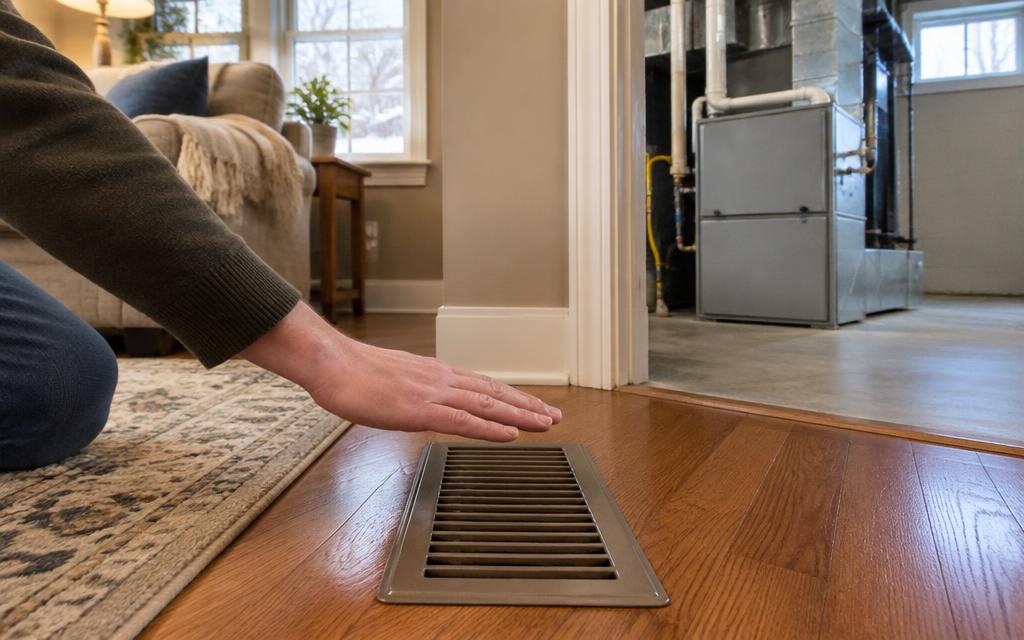
Two of the most common heating-season calls we take sound very different over the phone and often trace back to the same handful of conditions. In the first, the furnace is clearly running but the air coming out of the registers feels cool or lukewarm. In the second, the furnace lights, runs for a short time, shuts down, then tries again a few minutes later. Both can happen in the same house on the same night.
This guide is written for homeowners in Des Plaines, Chicago and the surrounding suburbs who want to understand what those symptoms usually mean before a technician arrives. It focuses on differentiating the symptoms and on what is safe to check yourself. It does not ask you to open a burner compartment, bypass a safety switch or keep resetting equipment that has shut itself down.
Cold air and short cycling are different symptoms
A furnace blowing cold air means the blower is moving air that the burners are not heating, or is moving it at the wrong point in the cycle. A furnace that short cycles is starting a heating cycle and ending it early, over and over, usually before the thermostat setpoint has been reached. One is about heat transfer and fan operation. The other is about how long the burner stays on.
The reason they get confused is that a short-cycling furnace often produces cool air too. Each aborted cycle ends with the blower running on to clear residual heat from the heat exchanger, so the last part of every short cycle feels cold at the register.
If you stand at a vent for ten minutes and feel warm, cool, warm, cool in a repeating pattern, you are most likely looking at short cycling rather than a furnace that never produces heat at all.
- Constant cool air while the blower runs nonstop: often a fan setting or a system that is not firing
- Warm air that turns cool after a couple of minutes, repeatedly: usually short cycling
- No air and no sound at all: a different problem — the system is not starting
For the broader diagnosis beyond this symptom, see what can cause a furnace to stop working; the visible FAQ separates safe observations from technician-only checks.
City homes can review residential furnace repair in Chicago.
If the furnace never starts at all and the wall control still shows a call for heat, our guide on a thermostat that says heat is on with no heat covers that sequence in detail.
The first thing to check: the thermostat fan setting
Before assuming equipment failure, look at the fan switch on the thermostat. If it is set to ON rather than AUTO, the blower runs continuously whether or not the burners are firing. Between heating cycles that air is room temperature or cooler, and on a cold Chicago day a stream of 68-degree air across your hand feels like cold air from a broken furnace. Setting the fan back to AUTO makes the blower run only during heating cycles.
Some homeowners deliberately run the fan continuously for air circulation or filtration, which is a legitimate choice. Just be aware that it changes what the registers feel like between cycles and can mask a real heating problem.
Restricted airflow: filters, closed vents and blocked returns
Airflow is the most common root cause behind both symptoms. A gas furnace is designed to move a specific volume of air across the heat exchanger. When that airflow drops, heat builds up inside the cabinet, and a high-limit switch shuts the burners off to protect the equipment. The blower keeps running to cool things down, you feel cool air, and a few minutes later the furnace tries again. That is textbook short cycling on limit.
The usual culprits are ordinary. A filter that has not been changed since the start of the season. A thick high-MERV filter in a system that was not designed for the added resistance. Supply registers closed in unused rooms. A return grille behind a sofa, a bookshelf or a laundry pile. Furniture rearranged in the fall is a surprisingly frequent cause in older Des Plaines and Park Ridge houses where return air comes from one or two central grilles.
- Replace or clean the air filter and note the date
- Open supply registers throughout the house rather than closing off rooms
- Clear anything blocking return-air grilles
- Check that a humidifier bypass damper is in its correct seasonal position
Overheating and the high-limit switch
The high-limit switch is a safety control, not a nuisance. When it opens, it is reporting that the air temperature inside the furnace rose beyond the design range. Restricted airflow is the usual reason, but a failing blower motor, a slipping or failed blower wheel, an undersized duct system or a stuck damper can produce the same result.
If new filters and open vents do not stop the pattern, stop troubleshooting there. Repeated overheating cycles are hard on the heat exchanger, and a heat exchanger is the component you least want to damage. Turn the system off and have it diagnosed.
Ignition interruption and flame sensing, at a high level
A furnace can also short cycle because it lights and then loses the flame signal. Modern furnaces confirm that a flame is present through a flame sensor. If that sensor is dirty, out of position or reading weakly, the control board closes the gas valve within seconds as a safety response, purges, and tries again.
Many systems allow a limited number of retries before locking out entirely. From inside the house, that looks like a furnace that fires briefly then goes quiet.
Flame-sensing problems, gas-valve behavior and burner condition belong to a licensed heating technician with the right instruments. Cleaning a sensor sounds simple and is routinely described online, but the surrounding components are gas-carrying and the diagnosis matters more than the cleaning.
If the igniter clearly glows and the burners still do not light, see our guide on an igniter that glows without a flame.
If the furnace starts and then shuts down hard on a safety control, a tripped rollout switch should be diagnosed rather than reset.
High-efficiency furnaces: condensate and pressure-switch faults
Condensing furnaces, generally those rated in the 90 percent range and higher, produce acidic condensate that has to drain away continuously. When the drain, trap or pump backs up, water can reach the inducer housing or pressure-switch tubing. The pressure switch then refuses to prove draft, the control board aborts the cycle, and the furnace makes short attempts to run without ever completing one.
This is common in the first cold weeks of the season, when a drain that sat dry all summer picks up debris or biological growth. Water on the floor near the furnace, a gurgling sound at the trap or a full condensate pump reservoir are all signals worth reporting when you call.
Our dedicated guide covers a clogged condensate drain causing a no-heat furnace and what should be tested before a pressure switch gets replaced.
When the furnace is simply too large for the house
Not all short cycling is a fault. A furnace with more heating capacity than the house needs satisfies the thermostat quickly, shuts off, and repeats. The house may still feel uneven, because rooms farthest from the equipment never get a long enough run to catch up. Homeowners often describe this as a furnace that blasts heat and then goes cold.
Oversizing usually comes from a replacement that matched the old nameplate instead of the actual load, especially in homes that have since added insulation or replaced windows. It is diagnosed by comparing run times, temperature rise across the furnace and a heat-loss calculation for the building — not by guessing from the model number.
If the system is older and repairs are stacking up, our guide on furnace repair versus replacement walks through age, repair history and comfort without promising a specific saving.
What not to do
Two habits turn a repairable problem into an expensive one. The first is bypassing or jumping a safety switch to keep the furnace running. Limit switches, rollout switches, pressure switches and flame sensing exist to shut the equipment down before it becomes dangerous. Defeating one removes the protection without fixing anything.
The second is repeatedly resetting a furnace that has locked out. Each reset sends the system through another ignition attempt under the same failed condition. If a furnace locks out once, note what you observed. If it locks out again, shut it off at the switch and request diagnosis.
- Do not jump, tape or bypass any safety control
- Do not cycle the power repeatedly to force ignition
- Do not close off supply registers to push heat elsewhere
- Do not ignore water, soot marks or burning odors near the equipment
When to shut the system off and call
Turn the furnace off at the service switch and request diagnosis if you smell gas, see soot or scorch marks, hear a booming sound at ignition, find water pooling near the equipment, or if the furnace has locked out more than once after a filter change. Also call if a carbon monoxide alarm sounds — leave the building first and contact the fire department or gas utility from outside.
For anything else, a short written note helps the technician: when the symptom started, how long each cycle lasts, whether the air is cool the entire time or only at the end, and what you have already changed.
Right Away provides furnace repair and no-heat diagnosis across Des Plaines and the surrounding suburbs.
You can also review our full range of heating services for installation, boiler and control work.
Chicago-area seasonal context
The first genuine cold snap of the season produces the heaviest concentration of these calls. Equipment that sat idle through the summer runs for hours at a stretch for the first time, and marginal conditions that were invisible in October show up immediately. Dust that settled on burners, a condensate trap that dried out, a filter left from spring, a return grille blocked by holiday furniture — all of them surface at once.
Older housing stock across Des Plaines, Park Ridge and the Chicago bungalow belt adds a second factor. Many of these homes have modest duct systems that were sized for the original equipment. When a high-efficiency furnace is installed without adjusting airflow, the system can overheat and short cycle on the coldest nights even though every component is functioning correctly.
See what we cover in Des Plaines, or browse all of the communities on our service-area list.
The full list of communities we serve includes the north and northwest suburbs along with Chicago.
Frequently asked questions
Why is my furnace blowing cold air when the heat is on?
The most common reasons are a thermostat fan switch left on ON instead of AUTO, a heating cycle that ended early and left the blower running to cool the heat exchanger, or a furnace that is not completing ignition. Check the fan setting and the air filter first, then request diagnosis if the pattern continues.
What does it mean when a furnace short cycles?
Short cycling means the furnace starts a heating cycle and shuts down before the thermostat setpoint is reached, then repeats. Restricted airflow leading to a high-limit trip is the most frequent cause, followed by flame-sensing problems, condensate or pressure-switch faults on high-efficiency systems, and equipment that is oversized for the house.
Can a dirty air filter make a furnace blow cold air?
Yes. A clogged filter restricts airflow across the heat exchanger, heat builds up, and the high-limit switch shuts the burners off while the blower keeps running. The result at the register is cool air. Replacing the filter is the first thing to try.
Is it safe to keep resetting a furnace that shuts itself off?
No. A lockout means a safety control interrupted the cycle. Repeated resets put the system through the same failed condition again without correcting it. Note what you observed, shut the furnace off at the service switch and request a diagnosis.
My furnace will not turn on at all. Is that the same problem?
Not usually. A furnace that produces no sound or airflow at all points toward power, the service switch, the thermostat or low-voltage controls rather than airflow or ignition. Our guide on a thermostat that says heat is on with no heat covers that sequence.
Who do I call for furnace repair in Des Plaines?
Right Away Plumbing and HVAC is located at 2093 Rand Rd, Des Plaines, IL 60016. Call 847-550-3322 for the suburbs or 773-250-6060 in Chicago, or request service through our website.
Talk to Right Away
Cold air at the registers and a furnace that will not stay running are usually solvable problems, and often they start with something as ordinary as a filter or a fan switch. What matters is stopping before the troubleshooting crosses into gas-carrying or safety components.
If the symptom persists after you have changed the filter, opened the registers and set the fan to AUTO, shut the system off and let a licensed technician take it from there.
You can read more about our plumbing services, check the communities we serve, or start with plumbing in Des Plaines and Park Ridge. Planning a remodel or weighing a big replacement? Our consulting service is built for that conversation.
Service areas for this work include Des Plaines and Chicago and Park Ridge. Questions about your building? Use our contact page.