95% High-Efficiency Furnace Maintenance: Why the Condensate Drain Matters Before Heating Season
· 11 min read · Right Away Plumbing & HVAC
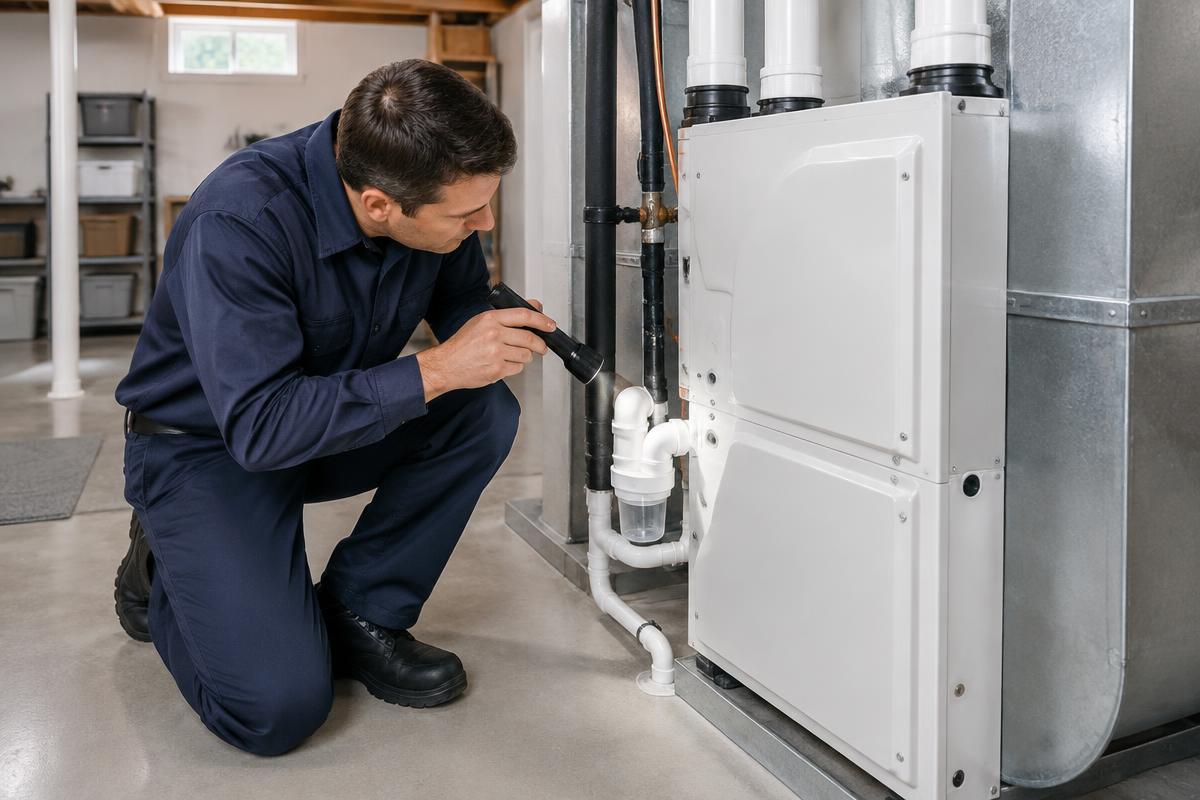
A 90%+ AFUE furnace is built around a simple idea: pull so much heat out of the flue gas that the water vapor in it condenses. That condensate is normal and expected. It only becomes a problem when it cannot leave the furnace.
Every fall we find the same thing in Des Plaines and across Chicagoland — a condensate trap, drain line or pump that has filled with sediment or biofilm over a long idle summer. The furnace then leaks onto the floor, or a pressure switch opens and the system locks out on the first cold night of the season.
This guide explains what the drain system does on a high-efficiency furnace, what blocks it, the warning signs worth acting on, and what a proper pre-season inspection should cover.
What makes a 95% furnace different
An older 80% AFUE furnace sends fairly hot flue gas straight up a vent. A condensing furnace at 90% or higher adds a secondary heat exchanger that extracts additional heat from those gases before they leave the building. Trane describes this same arrangement in its explanation of condensing furnaces: the secondary heat exchanger is what makes the higher efficiency rating possible.
Because the flue gas leaves much cooler, a condensing furnace vents through PVC or similar plastic pipe rather than a masonry chimney, usually with a sealed intake pipe drawing combustion air from outside. And because the gas is cooled below its dew point, the furnace produces liquid water every time it runs.
- Primary and secondary heat exchangers rather than one
- Plastic intake and exhaust piping, typically terminating through a sidewall
- A condensate trap and drain line as standard equipment
- A condensate pump when there is no gravity drain nearby
- Pressure switches that monitor the induced-draft and drainage path
For the broader diagnosis beyond this symptom, see what can cause a furnace to stop working; the visible FAQ separates safe observations from technician-only checks.
City homes can review residential furnace repair in Chicago.
Trane's overview of the design is available in its condensing furnace explainer.
Why high-efficiency furnaces produce condensate
Burning natural gas produces water vapor. In a standard-efficiency furnace that vapor stays hot enough to exit as gas. In a condensing furnace the secondary heat exchanger cools the flue gas below its dew point, so the vapor turns back into liquid inside the equipment.
That water is mildly acidic. It collects in the heat exchanger and inducer housing, flows down through the furnace's drain trap, and travels through a drain line to an approved drain — a floor drain, a laundry standpipe, or a condensate pump that lifts it to one.
Carrier makes the same point in its homeowner guidance on furnaces leaking water: high-efficiency furnaces create condensate by design, and when the drain is blocked that water backs up and finds its way out of the equipment.
Carrier's guidance is published in its furnace leaking water article, and Trane covers the same failure in its
What clogs the drain, trap or pump
Blockages build up gradually. Some of it accumulates while the furnace runs through a heating season; some of it develops while the equipment sits idle and the trap holds standing water for months. On a shared drain, cooling-season condensate from the evaporator coil can contribute as well. What matters is not where every particle came from — it is that the path has to be verified open before the heating season, not assumed open.
- Slime and biofilm growth inside a trap or line that has held standing water
- Dust and fine debris drawn into the cabinet and washed into the drainage path
- Sediment and scale settling in the trap body
- Insects, insulation fragments or construction debris entering an open line
- A drain line that sags, kinks or lost its proper slope
- A trap that dried out, lost its prime and is no longer sealing correctly
- A condensate pump with a fouled float, a clogged check valve or a failed motor
- A discharge tube from the pump that is pinched, disconnected or blocked
Why the trap matters as much as the line
The trap does two jobs: it carries condensate away and it maintains a water seal so the furnace cannot pull air backward through the drain. Daikin's installation and service guidance is explicit that the drain trap and line must be correctly routed and primed, and that the condensate drainage system should be inspected annually for blockage and leaks. A trap that is clogged, dry or plumbed incorrectly can affect the pressure-switch circuit even when the visible drain line looks clear.
Warning signs worth acting on
A condensate problem rarely announces itself politely. These are the symptoms that bring us out most often in September and October:
- Water pooling on the floor around the furnace or under the cabinet
- A wet or stained furnace base, or rust forming on the cabinet bottom
- Gurgling or bubbling from the trap area during operation
- The furnace starting, running briefly, then shutting down repeatedly
- A lockout code on the control board after several failed attempts
- No heat at all on the first genuinely cold night
- A condensate pump that runs constantly, never runs, or hums without moving water
- A pump's overflow safety switch tripping and stopping the equipment
- A visibly discolored, cloudy or sludge-filled drain line
- Water damage on nearby drywall, storage or flooring in a finished basement
Why a drain clog can stop the heat
When condensate cannot drain, it backs up into the inducer housing or heat exchanger passages. That restricts the draft path, the pressure switch does not see the proof it expects, and the control board refuses to light the burners. The result is a nuisance shutdown or a hard lockout — the furnace is protecting itself, not failing randomly.
A safety switch on a condensate pump does the same thing intentionally: it stops the equipment rather than letting water overflow onto the floor.
If the furnace shuts down before producing heat, our guide on a clogged condensate drain and a furnace that will not run walks through the same symptoms in more detail, and
furnace repair covers diagnosis and correction.
What annual pre-season maintenance should cover
A meaningful tune-up on a condensing furnace is more than a filter change. On a 90%+ system, the drainage and combustion-air side of the equipment deserves as much attention as the burners.
- Inspect and clean the condensate trap, drain line and any drainage fittings, and re-prime the trap
- Verify the drain line has continuous fall to an approved drain with no sags or kinks
- Test the condensate pump, float, check valve, discharge tubing and overflow safety switch
- Check the inducer motor and confirm the pressure-switch sequence proves correctly
- Inspect the intake and exhaust terminations for nests, screens, debris, ice risk and correct clearance
- Clean the flame sensor and verify the ignition sequence and flame signal
- Inspect burners and check gas pressure against the manufacturer's specification
- Replace or correct the filter and verify airflow and temperature rise are within the rating plate range
- Visually inspect the heat exchanger and flue passages and perform the manufacturer-recommended testing
- Check combustion and venting, and verify safety controls operate as designed
Timing the inspection
Daikin's service guidance recommends inspecting the heat exchanger flue passages at the beginning of the heating season, alongside an annual check of the condensate drain system for blockage and leaks. That timing is deliberate: it catches problems that developed during the idle months before the equipment is asked to run daily.
Follow the maintenance interval and procedures in your own furnace's manufacturer documentation. Requirements differ between brands and models.
This work is part of our heating system inspections and general
Heat exchangers and carbon monoxide: a separate issue
It is worth being precise here, because this subject gets exaggerated online. A clogged condensate drain does not automatically crack a heat exchanger, and it does not by itself mean carbon monoxide is entering your home. A drain clog typically causes water backup, leaks and shutdowns.
A cracked or failed heat exchanger is a different and serious condition. Because the heat exchanger separates combustion gases from the air circulated through the house, a breach can allow those gases — including carbon monoxide — to reach the living space. That is why a visual inspection of the heat exchanger and flue passages, along with manufacturer-recommended testing and a combustion and venting check, belongs in every annual service.
Standing water, corrosion and repeated nuisance shutdowns are all reasons to have the equipment looked at properly rather than left running unattended. The point is not alarm. The point is that both conditions need a qualified technician, for different reasons.
Carbon monoxide alarms
Every home with fuel-burning equipment should have working carbon-monoxide alarms, installed and located according to the alarm manufacturer's instructions and local requirements, and tested regularly.
If a carbon-monoxide alarm activates, leave the area, get everyone outside and follow the emergency guidance for your area. Do not stay inside to troubleshoot the furnace. Seek medical attention if anyone has headache, dizziness, nausea or unusual fatigue.
Carbon monoxide has no odor, so the absence of a smell does not confirm that fuel-burning equipment is operating safely.
When to call before the first cold snap
Scheduling in early fall is simply easier than scheduling in January. Parts are available, appointment windows are wider, and a drain clean is a routine visit rather than a no-heat call.
- The furnace is 90%+ AFUE and has not been serviced in the past year
- You have seen water near the equipment at any point
- The furnace short-cycles, locks out or throws a fault code during a test run
- There is a condensate pump you have never had checked
- The furnace sits in a finished basement where a leak would cause damage
- The equipment is older and you are weighing another season against replacement
If the system is near the end of its life, our guide on furnace repair versus replacement covers the decision, and we handle
furnace installation when replacement is the better value.
Related heating problems we see the same week
Condensate trouble is one of several reasons a furnace refuses to run in the fall. If the symptoms do not match what you are seeing, these may:
A thermostat calling for heat with nothing happening is covered in thermostat says heat is on but there is no heat. A furnace that shuts down on a safety control is covered in
what a tripped rollout switch means. If the igniter glows but the burners never light, see
igniter glows but no flame. And for odors during the first startup, read
Service across Des Plaines, Chicago and the suburbs
Right Away Plumbing & HVAC is based at 2093 Rand Rd, Des Plaines, IL 60016, and we are licensed, bonded and insured. We service high-efficiency furnaces, boilers and heat pumps throughout Chicago and the northwest suburbs.
Call 847-550-3322 for Des Plaines and the suburbs, or 773-250-6060 for Chicago, to schedule a pre-season inspection.
See coverage details for Des Plaines,
Chicago and every town on our
service areas page, or reach us through the
Frequently asked questions
Does a 95% efficient furnace make water?
Yes. A 90%+ AFUE condensing furnace uses a secondary heat exchanger that cools the flue gas below its dew point, so water vapor condenses into liquid. That condensate is normal and is supposed to flow through the furnace's drain trap and drain line to an approved drain, or through a condensate pump to one.
Can a clogged condensate drain stop a furnace from running?
It can. When condensate cannot drain, water backs up into the inducer housing or heat exchanger passages and restricts the draft path. The pressure switch then fails to prove, and the control board will not light the burners, which shows up as short cycling, a lockout code or no heat. A condensate pump's overflow safety switch can also shut the equipment down deliberately.
Why is my high-efficiency furnace leaking water?
The most common cause is a blocked or clogged condensate trap, drain line or condensate pump, which makes the water back up and escape from the equipment. Other causes include a disconnected or sagging drain line, a cracked trap or fitting, or a pump discharge tube that is pinched or detached. Manufacturers including Trane and Carrier identify clogged condensate drainage as a leading reason a high-efficiency furnace leaks water.
Can a clogged condensate drain cause carbon monoxide?
A clogged drain does not by itself produce carbon monoxide or crack a heat exchanger. It typically causes water backup, leaks and nuisance shutdowns. A cracked or failed heat exchanger is a separate and serious condition that can allow combustion gases, including carbon monoxide, to escape into the air circulated through the home.
That is why annual professional service should include a heat exchanger and flue passage inspection along with a combustion and venting check. Every home with fuel-burning equipment should also have working carbon-monoxide alarms installed according to the manufacturer's and local guidance.
How often should the condensate trap be checked?
At least once a year, and ideally before the heating season begins. Manufacturer service guidance, including Daikin's, calls for inspecting the condensate drain system annually for blockage and leaks and for confirming the trap and line are properly routed and primed. Follow the interval specified in your own furnace's documentation.
Should I run my furnace before winter?
Yes. Running a full heating cycle in early fall, while the house is still comfortable, is the easiest way to find an ignition, drainage or control problem before you depend on the equipment. If the furnace leaks water, short-cycles, locks out or produces a fault code during that test, schedule service then rather than during the first cold snap.
Talk to Right Away
A condensing furnace is designed to make water, and the drainage path is the part most often left unchecked. Cleaning the trap and line before the season is routine work that prevents leaks, water damage and no-heat calls.
Call 847-550-3322 in Des Plaines and the suburbs or 773-250-6060 in Chicago to schedule a pre-season high-efficiency furnace inspection.
You can read more about our plumbing services, check the communities we serve, or start with plumbing in Des Plaines and Park Ridge. Planning a remodel or weighing a big replacement? Our consulting service is built for that conversation.
Service areas for this work include Des Plaines and Chicago and Park Ridge and Mount Prospect. Questions about your building? Use our contact page.